


Overview
The lush southern state of Kerala, nicknamed “God’s Own Country,” is another favorite among foreign visitors looking for nature, relaxation, and a slower pace. A classic Kerala itinerary focuses on three experiences: exploring the historic coastal city of Kochi (Cochin), unwinding on a houseboat cruise through the backwaters (Alleppey or Kumarakom), and enjoying the cool climate of a tea plantation hill station like Munnar. Often, travelers also include Periyar Wildlife Sanctuary(Thekkady) for a jungle and spice plantation experience, or some beach time in Kovalam or Varkala. In about a week you can see the core highlights: Kochi → Munnar → Alleppey/Kumarakom backwaters → depart via Kochi or Trivandrum. Kerala offers a completely different atmosphere from North India: tropical greenery, serene waterways, and a blend of Indian and colonial heritage. It’s especially popular for those interested in ayurvedic wellness, nature, and a laid-back vibe.
Highlights and stops
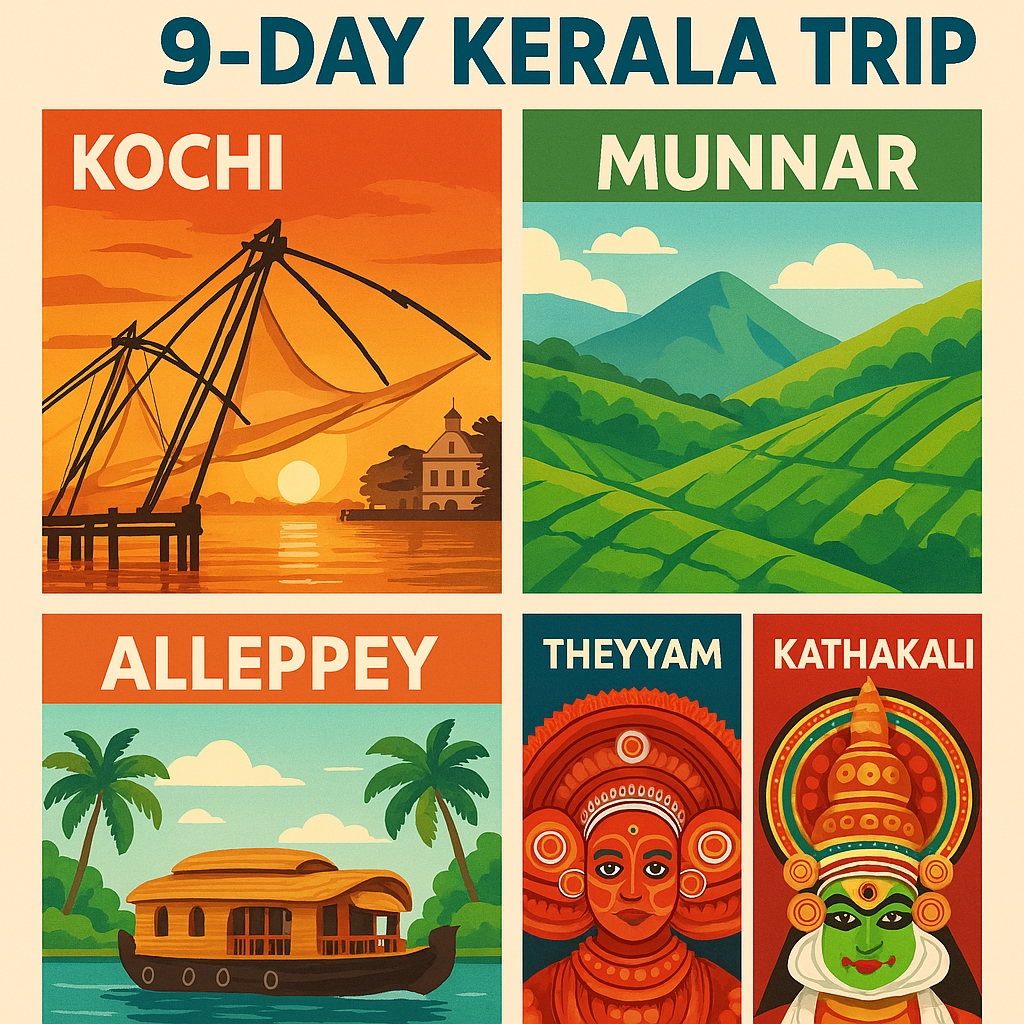
• Kochi (Cochin): A historic port city with a mix of cultures (Portuguese, Dutch, British influence). In Fort Kochi area you’ll see charming colonial architecture, the famous Chinese fishing nets along the shore, St. Francis Church (Vasco da Gama’s burial site), the Santa Cruz Basilica, and the Mattancherry Palace (Dutch Palace) with its Kerala murals. Jew Town and the Paradesi Synagogue reflect Kochi’s Jewish heritage. It’s a great place to stroll through art cafes and spice markets. Many itineraries begin here due to Kochi’s international airport.
• Munnar: A hill town in the Western Ghats at about 1,600 m altitude, once a British-era tea planting region. The scenery is stunning – rolling hills carpeted
with tea gardens, misty mountains, and cool weather. Visitors enjoy touring a tea plantation and factory, visiting viewpoints like Top Station or Echo Point, perhaps hiking in Eravikulam National Park (home to the Nilgiri tahr mountain goat). Munnar provides a refreshing break from the lowland heat – temperatures here can drop to 10°C at night even when the coast is hot.
• The Backwaters (Alleppey & Kumarakom): The Kerala backwaters are an extensive network of tranquil lakes, canals, and rivers parallel to the Arabian Sea coast. Alleppey (Alappuzha) is the hub for houseboat cruises – converted traditional rice barges (“kettuvallam”) that serve as floating cottages. Tourists typically spend a day and night on a houseboat, drifting through palm-fringed canals, passing village life (kids rowing to school, women washing clothes at the water’s edge), and enjoying freshly cooked Keralan food on board. It’s peaceful and romantic. Kumarakom, on Lake Vembanad, is another backwater destination known for bird sanctuary and high-end backwater resorts – one can do shorter rice boat rides or stay in a lakeside resort here.
• Thekkady (Periyar): Often included if time permits – a wildlife sanctuary in the Cardamom Hills where you can take a boat safari on Periyar Lake to spot elephants, bison, and if lucky, maybe a tiger (though sightings are rare). The area is famous for spice plantations (pepper, cardamom, etc.) – plantation tours are popular. This lies between Munnar and the backwaters, so it fits in a loop.
• Beaches (optional): If one has more time in Kerala, they might head to a beach town at the end. Varkala (the clifftop beach popular with backpackers) or Kovalam (well-developed resort beach) are in south Kerala near Trivandrum (Thiruvananthapuram). These could extend the itinerary by 2-3 days for some sun and sea. Some tours skip the beach if travelers are continuing to Goa or elsewhere for that.
Travel logistics
Kerala is relatively compact. Kochi to Munnar is ~130 km, which is a ~4- hour winding drive up the hills. Munnar to Thekkady (Periyar) is another ~3-4 hours by road. Thekkady down to Alleppey is ~4-5 hours by road. These mountain roads are scenic but slow; hiring a private car/driver is common for flexibility. Alternatively, there are good public AC buses and even a few trains (but no train to Munnar due to mountains). Kochi to Alleppey is only 1.5 hrs by road (55 km) and Kochi to Kumarakom about the same – quite accessible. Kochi to Trivandrum (for Kovalam) is a 4-5 hour train or drive (~200 km). Many itineraries will be a loop: Kochi -> Munnar -> Thekkady -> Alleppey/Kumarakom -> Kochi (or Trivandrum).
Houseboat cruise typically starts around noon in Alleppey, goes through backwaters, and moors by evening; you sleep on board and disembark next morning – the houseboat operators often arrange pickup/dropoff with your driver or train station. Note that in monsoon months some smaller backwater canals might be closed to boats due to high water, but generally houseboats operate year-round.
Trains: Kerala has a railway along the coast – useful for covering long distances (e.g., Kochi to Trivandrum). But inland like Munnar has none.
Internal flights: Kochi has flights from major cities; Trivandrum also does. If one wanted to connect Kerala with, say, Delhi or Mumbai, flying into Kochi and out of Trivandrum can save backtracking.
Seasonal considerations
Kerala has a tropical climate with heavy monsoons. The best time to visit is during the dry winter and early spring (November through March). During these months, the weather is warm but not too humid on the coast (around 30°C), and pleasantly cool in the hills. December–February are peak season with many European charter tourists and NRIs; all resorts are fully operational. Monsoon season is significant here, roughly June to September (southwest monsoon) and a secondary monsoon in October-November (northeast monsoon, shorter). Monsoons bring torrential rain almost daily. While some travelers actually seek out Kerala in the monsoon for Ayurvedic treatments (monsoon is considered a rejuvenation time in Ayurveda) or to enjoy the romantic rain, it’s off-season for general tourism. Houseboats still run but you might be confined to indoor if it pours continuously; some remote areas flood; leeches in the jungle hikes of Periyar are a nuisance then. On the plus side, monsoon Kerala is incredibly green and all waterfalls are flowing – but one must be okay with rain. Summer (March–May) is hot and humid on the coast (32–36°C plus high humidity), but Munnar will be cooler (20–25°C). So travelers who come in, say, April often appreciate time in the hill station to escape the coastal heat. Wildlife sightings in Periyar can be harder in monsoon(dense foliage) but better in the dry season when animals come to the lake.
Another consideration
Kerala has some unique festivals – e.g., the grand Thrissur Pooram festival (April/May) with elephant processions, or Onam (Aug/Sep, harvest festival) with snake-boat races.

Attending those could be memorable if timing matches, but they occur in the less touristy times (Onam is in monsoon). The backwaters are enjoyable year-round, though the best weather for backwaters is Nov– Feb when humidity is lowest and skies clear. We at Travebrate, are experts in curating travel to Indian festivals. You can download India Fest app to validate if there are any such experiences are happening in India during your India Visit.
Pros:
Kerala offers a relaxing, scenic break and a chance to experience India’s natural beauty and hospitality. The backwater cruise is often a highlight – very unique to Kerala, allowing you to literally live on the water for a day, which foreigners often find magical. The scenery from misty hills with tea gardens to coconut palm lagoons is spectacular and varied within short distances. Kerala also is known for being relatively cleaner and well literate (it has 90%+ literacy), which can make travel easier (communication, etc.). The food is a big pro for many – delicious Kerala cuisine (think fresh fish curry, coconut based dishes, tropical fruits) and also lots of vegetarian fare and tea/coffee. Many travelers do an Ayurvedic massage or yoga retreat as part of this itinerary – Kerala is the home of Ayurveda, with certified Ayurvedic spas and resorts offering treatments ranging from general massage to multi-day wellness packages. Culturally, seeing the Kathakali dance performance in Kochi or a Kalaripayattu (martial arts) show can be enriching. Overall, this itinerary is perfect for those seeking a slower pace after the hustle of North India – it’s about leisurely enjoyment rather than rushing through monuments.
Cons:
If one expects the grand monuments of North India, Kerala doesn’t have many big-name monuments (no “Taj Mahal” equivalent). The attractions are more nature and lifestyle-oriented, which some travelers looking for historic sites might find less engaging. Also, Kerala’s tourism is quite developed, meaning certain areas (like parts of Munnar or Alleppey) have many tourists – during peak season the backwaters have a flotilla of houseboats (you won’t be entirely alone on the waters). There have been concerns about over-development of houseboats affecting the environment. Another potential con is weather – outside of the ideal window, it can be oppressively humid or very wet. Those sensitive to heat might struggle in the coastal region if not in winter. Additionally, transport can be slow on narrow roads; while distances aren’t huge, winding hill roads can mean a 100 km journey takes half a day. Some travelers who only have a week in India might skip Kerala because it’s far from the Golden Triangle (requires a 3-hour flight from Delhi). But for those with time or focusing only on South India, it’s unmissable.
Guide and services
Kerala has plenty of tour operators and licensed guides, especially in Kochi and for the Periyar sanctuary. In Kochi, many local guides (including those trained under the government Incredible India program) offer city tours and market tours. On the backwaters, typically you don’t have a “guide” – the boat crew itself(captain and cook) take care of you, and they can point out things informally. If you want deeper interpretation(bird watching, village life explanation), you could arrange a guide to accompany on the houseboat, but most people just relax. If you need a guide reach out to us. In Periyar, forest department guides lead nature walks and boat rides have a guide commentary. Munnar has naturalist guides for treks if desired. Language is generally no problem – Kerala’s education level means even rural folks often know some English. Also, Kerala tourism has official information centers in Kochi and elsewhere where you can find government certified guides. Having a driver through the trip often doubles as having a knowledgeable local with you. Hotels and homestays in Kerala are known for warm service – hosts often themselves guide guests on spice garden tours or cooking demos.
Costs:
Kerala is quite affordable for what it offers. Houseboat prices vary by comfort level – roughly ₹6,000–8,000 ($75–100) per night for a private one-bedroom houseboat with meals for two is common (high-end luxury boats cost more). Homestays and guesthouses in Kochi or Alleppey can be as low as $25–40 a night(and often include home-cooked breakfast). Good resorts in Munnar or backwaters might be $80–150. A private driver for a week in Kerala might charge around ₹5,000 per day ($60) including car and fuel, so split among a group that’s decent. Entry fees are minimal – most sights like churches or tea plantations are cheap, Periyar park fee maybe ₹500. One splurge could be an Ayurvedic massage: expect ~₹1500–3000 ($20–40) for a 60-90 minute session at a reputable center. Food is inexpensive: local Kerala meals (thali or seafood) might be $5-10 for a big meal. Therefore, a moderate budget for 1 week in Kerala could be around $500–700 per person, while budget travelers could do less by using public transport (very cheap) and homestays. Many foreigners also travel Kerala independently using trains and buses since it is safe and tourist-friendly. For example, a train from Kochi to Trivandrum is only a few dollars. Because of this affordability and beauty, Kerala frequently ranks among the top value destinations, and many backpackers and luxury tourists alike include it. The state tourism board is active, ensuring a generally good experience for visitors. In sum, this itinerary offers a tranquil escape with a mix of culture and nature, an excellent complement to the hustle of India’s big cities.
Travebrate as your travel advisor
Travebrate is India’s leading travel planner, specializing in curating personalized itineraries that go far beyond simple checklists or standard tourist circuits. We take pride in weaving your interests—whether that’s cultural festivals, heritage walks, or animal-centric events—directly into your travel experience, ensuring each journey is as unique as you are. Unlike traditional agencies, we focus on authentic and immersive experiences, including local festivals and seasonal happenings, so you can witness India’s true vibrancy first-hand.
If you’re passionate about India’s festivals, don’t miss our India Fest app—it’s the perfect way to discover major events like Kambala, Ganapathi Visarjan, and the mesmerizing snake boat races. Did you know Kerala hosts some of the most unique and spectacular festivals in the country, from Thrissur Pooram to Attukal Pongala? Explore these celebrations right through our India Fest app and enrich your itinerary. Ready for an extraordinary Indian experience? Reach out to us on our India Itinerary page and let us help you plan your next unforgettable adventure.