


Holi date, types of Holi across India, the complete Braj calendar, and hidden Himalayan festivals: everything you need to plan the perfect Holi trip.
When is Holi in 2027?
Holi 2027 falls on 21st and 22nd March across most of India, with the bonfire ritual Holika Dahan on the evening of 21st March, and the iconic colour play Rangwali Holi on 22nd March 2027. These dates follow the Kashi Narayana Panchang, the traditional almanac we use as our reference for Holi festival timings.
But here’s what most travellers don’t know: Holi in India isn’t one event on one day. Depending on which part of India you travel to, the festival stretches from mid-March all the way to early April, and each version is a completely different experience.
What is Holi? The Story Behind the Colours
Holi isn’t just about drenching strangers in pink powder. It carries centuries of meaning.
The festival originates from the story of Prahlada, a devoted follower of Lord Vishnu, and his aunt Holika, who tried to destroy him in fire, only for the flames to spare him and consume her instead. The bonfire of Holika Dahan re-enacts that victory of devotion over evil.
The tradition of throwing colours traces back to Lord Krishna, famously mischievous, who is said to have playfully coloured Radha and the Gopis of Vrindavan. That spirit of joy, love, and playful chaos lives on in every splash of gulal thrown today.
Holi also marks the farewell of winter and the arrival of spring: a time of new beginnings, forgiveness of old grudges, and coming together across caste, class, and community.
The Braj & Beyond Holi 2027 Calendar: India’s Greatest Festival Season
The Braj region of Uttar Pradesh, home to Mathura, Vrindavan, Barsana, Nandgaon and Gokul, is the spiritual heartland of Holi. While the rest of India celebrates for a day or two, Braj celebrates for over 10 days, with each town running its own signature event rooted in the mythology of Radha and Krishna. And in the Himalayas, the celebrations continue well into late March.
Here is the complete date-wise Holi 2027 calendar across India:
| Date | Day | Event | Location |
|---|---|---|---|
| 16 March | Tuesday | Laddu Holi | Radha Rani Temple, Barsana |
| 17 March | Wednesday | Lathmar Holi | Barsana (Navami Tithi) |
| 18 March | Thursday | Lathmar Holi | Nandgaon |
| 18 March | Thursday | Rangbhari Ekadashi + Masan Ki Holi Day 1 | Kashi Vishwanath Temple & Harishchandra Ghat, Varanasi |
| 19 March | Friday | Masan Ki Holi (Main) | Manikarnika Ghat, Varanasi |
| 20 March | Saturday | Widow Holi | Vrindavan |
| 21 March | Sunday | Holika Dahan | All of Braj; across India |
| 21 March | Sunday | Sangla Holi, Day 1 | Sangla Valley, Kinnaur, Himachal Pradesh |
| 22 March | Monday | Rangwali Holi (Main Holi) | Mathura, Vrindavan, and all of India |
| 22 March | Monday | Sangla Holi, Day 2 | Sangla Valley, Kinnaur, Himachal Pradesh |
| 23 March | Tuesday | Sangla Village Processions | Surrounding villages, Sangla Valley |
| 23 March | Tuesday | Huranga (Dauji Holi) | Dauji Temple, Baldev, near Mathura |
| 24–28 March | Wed–Sun | Raulane Festival (dates to be confirmed locally) | Kalpa & Kinnaur villages, Himachal Pradesh |
The festival season truly ignites after Rangbhari Ekadashi (18 March), the day Lord Shiva is believed to return to Kashi with Goddess Parvati, triggering both the Varanasi Holi and the final sprint of Braj celebrations.
The Different Types of Holi Celebrated in India
India doesn’t do Holi in one flavour. Here are the most spectacular regional versions, each one a reason to plan a trip:
1. Laddu Holi, Barsana, Uttar Pradesh
When: 16 March 2027 (Tuesday)
The Braj season opens not with sticks or gulal, but with sweets. At the Radha Rani Temple in Barsana, priests and devotees playfully throw laddus instead of colours. It’s devotional, joyous, and relatively intimate, a beautiful way to ease into the Braj Holi season before the crowds arrive.
Best for: Those who want to begin the Braj journey early, devotees, families
2. Lathmar Holi, Barsana & Nandgaon, Uttar Pradesh
When: 17 March, Barsana (Navami Tithi) | 18 March, Nandgaon | 2027
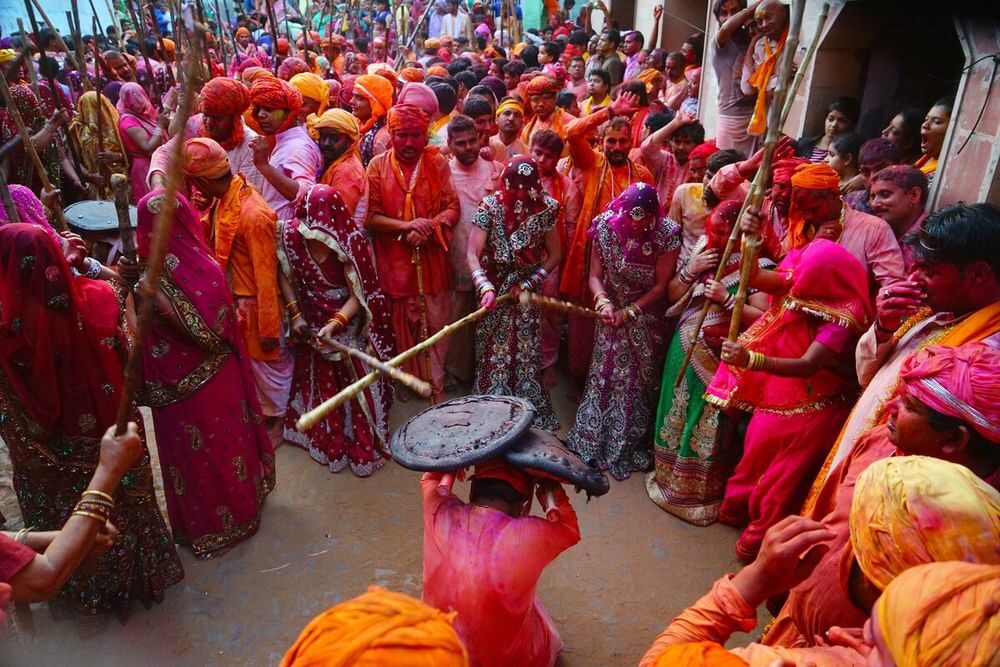
The most iconic variant of Holi on the planet. In Barsana, Radha’s village, women playfully beat men from Nandgaon (Krishna’s village) with wooden lathis, while the men defend themselves with leather shields and try to drench the women with colour. The next day the roles reverse in Nandgaon. It re-enacts the mythological tale of Krishna teasing the Gopis. The Shri Radhika Temple overflows with devotees, gulal clouds the air, and folk musicians fill the lanes with sound.
Best for: Mythology lovers, photographers, bucket-list travellers
3. Phoolon Wali Holi (Flower Holi), Vrindavan, Uttar Pradesh
When: Around 18–19 March 2027
At the Banke Bihari Temple in Vrindavan, priests shower devotees with tonnes of rose petals and marigolds instead of colour powders. The air turns fragrant and golden. This is Holi at its most devotional and visually stunning, dedicated to the pure love of Radha and Krishna. Far gentler than the street celebrations, it attracts those who want the spiritual essence of Holi without the chaos.
Best for: Spiritual travellers, those who want Holi without the colour free-for-all
4. Masan Ki Holi (Ash Holi), Varanasi, Uttar Pradesh
When: 18 March, Harishchandra Ghat (Rangbhari Ekadashi) | 19 March, Manikarnika Ghat (Main) | 2027
Nothing in India prepares you for Masan Ki Holi. While the rest of the country gears up for gulal and water guns, the ancient city of Varanasi pauses to celebrate the most mystical and intense version of Holi imaginable: at its cremation grounds, with ash from funeral pyres instead of colour.
Masan means cremation ground. The ritual is observed at Manikarnika Ghat and Harishchandra Ghat, two of the most sacred, continuously burning ghats in India, by Aghori sadhus, Shaivite devotees, and priests. According to legend, after celebrating Holi with Goddess Parvati, Lord Shiva descended to the cremation grounds and played Holi with spirits and ascetics using sacred ash (bhasma). The ash doesn’t represent morbidity here; it represents impermanence, liberation, and the eternal cycle of creation and dissolution.
Nearly 20,000 people gather at Manikarnika Ghat. Over 150 kilograms of ash are used during the celebrations, mixed with gulal to create a surreal and haunting visual. The ritual is not a performance for tourists; it is a living spiritual practice. Visitors are welcome to observe, but should approach with deep respect.
In 2027, the two-day sequence begins on 18 March at Harishchandra Ghat, the same day as Rangbhari Ekadashi, when Lord Shiva is believed to return to Kashi with Goddess Parvati and special rituals are held at Kashi Vishwanath Temple. The main and more intense celebration follows on 19 March at Manikarnika Ghat.
Best for: Serious travellers, spiritual seekers, those looking for a profound and unconventional experience
5. Chhadi Maar Holi, Gokul, Uttar Pradesh
When: Around 19–20 March 2027
In Gokul, the village where the infant Krishna was secretly raised, the tradition of Chhadi Maar Holi carries forward another playful chapter of his mythology. Women ceremonially strike men with sticks (chhadi) in a lighter, more devotional echo of the Lathmar tradition. The atmosphere in Gokul is quieter and more intimate than Barsana.
Best for: Those doing the full Braj circuit, travellers seeking a lesser-crowded Holi experience
6. Huranga (Dauji Holi), Baldev, near Mathura
When: 23 March 2027 (day after Rangwali Holi)
The final chapter of Braj Holi, celebrated at the Dauji Temple in Baldev the day after Rangwali Holi. Huranga is high-energy, exuberant, and distinctly local, a fitting crescendo to the entire 10-day Braj season.
Best for: Those staying on in Braj to experience the full arc of the festival
7. Rangwali Holi / Dhulandi, Mathura, Vrindavan, Delhi, Jaipur
When: 22 March 2027
The version the whole world knows. Streets, terraces, and open grounds become a canvas of red, blue, green, and yellow. Mathura and Vrindavan host week-long celebrations leading up to this day. Jaipur brings a royal edge, with folk performances and processions from the City Palace. Delhi hosts large public events across the city.
Best for: First-time Holi travellers, group trips, maximum energy and celebration
8. Hola Mohalla, Anandpur Sahib, Punjab
When: 22–24 March 2027 (the day of and after Holi, extended over three days)
Introduced by Guru Gobind Singh as a counterpart to Holi, Hola Mohalla is the Sikh community’s festival of strength and courage. Martial arts displays, mock battles, Gatka performances, and massive community feasts (langars) replace colour play. The sheer scale of devotion and skill on display is humbling.
Best for: Cultural immersion, travellers interested in Sikh heritage, those seeking something beyond colours
9. Widow Holi, Vrindavan, Uttar Pradesh
When: 20 March 2027
For decades, widows in India were socially barred from celebrating Holi. Considered inauspicious, they were expected to observe the festival in silence and grey. At the Pagal Baba Ashram in Vrindavan, that changes. On the day before Holika Dahan, hundreds of widows, many of them elderly women who have lived in Vrindavan’s ashrams for years, gather to play Holi with flowers and gulal, dressed in white saris gradually transforming to pink and red.
This is one of the most quietly powerful images in all of India’s festival landscape: women reclaiming colour, joy, and visibility in the very city associated with Krishna’s eternal celebration of life. Widow Holi has grown steadily in recognition and now draws attention from across the world. The atmosphere is deeply emotional and warmly communal.
Best for: Travellers seeking depth over spectacle, those interested in social change, photographers
10. Sangla Holi (Faguli Festival), Sangla Valley, Kinnaur, Himachal Pradesh
When: 21–22 March 2027 (Holi days) | 23 March 2027 (Village Processions)
Hidden in Himachal Pradesh’s Baspa Valley, at the foot of the Kinner Kailash range, is one of the most visually breathtaking and culturally rich ways to experience Holi in India. In Sangla, the festival is part of a four-day Faguli celebration, a unique blend of Holi and Diwali that belongs entirely to the Kinnauri people.
The Faguli Festival marks the end of long Himalayan winter isolation and the arrival of spring. On the first days, villagers gather at the Nag Temple for prayers and ritual offerings. Traditional Kinnauri instruments, dhol, karnal and shehnai, lead processions through the village. On 21 March, Holika Dahan is observed in the Kinnauri tradition. On 22 March, the main Holi day, the entire valley gathers at Sangla Chowk dressed in white, playing Gulaal wali Holi and, in the Himachal tradition, with snow. The evening brings oil lamps, reminiscent of Diwali, casting a warm glow against the snow-white peaks.
On 23 March, the celebrations spill beyond the village centre. Traditional processions wind their way to surrounding villages, a moving, musical spectacle where the deity is carried through the valley accompanied by folk music, dance, and community ritual. This is the part most travellers miss, and often the most intimate and memorable day of the entire festival.
For international visitors: Kinnaur is a protected area requiring an Inner Line Permit (ILP), which should be applied for at least 30 days in advance. March temperatures in Sangla range from 10°C in the day to -5°C at night. Heavy woolens are essential, and road closures due to snowfall are possible.
Best for: Adventure travellers, photographers, those who want Holi against a Himalayan backdrop unlike any other
11. Raulane Festival, Kalpa & Kinnaur Villages, Himachal Pradesh
When: 24–28 March 2027 (indicative, confirm locally, as exact dates vary by village)
If Sangla Holi is extraordinary, Raulane is otherworldly.
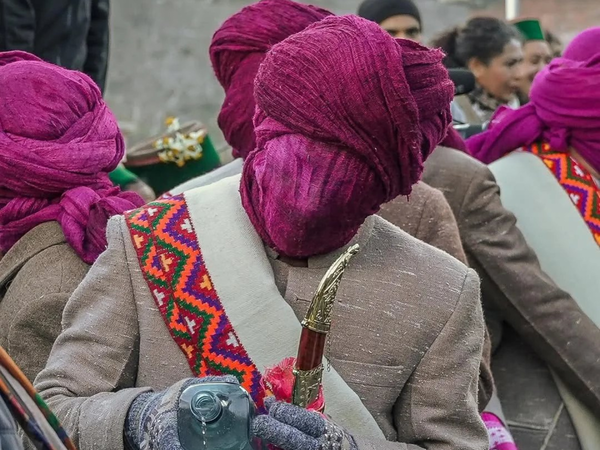
Celebrated in Kalpa and surrounding villages in Kinnaur, Raulane is one of the oldest surviving winter-spring traditions in the Himalayas, with local oral tradition claiming it is over 5,000 years old. The festival marks the farewell of the Saunis, celestial fairy-spirits believed to descend from the mountains during winter to protect villages from the harsh cold. As spring arrives, the community gathers to thank these spirits and ceremonially bid them farewell.
The centrepiece is extraordinary: two men, the Raula (groom) and the Raulane (bride), are dressed in elaborate traditional Kinnauri women’s attire, adorned with antique silver and gold jewellery. They perform a slow, meditative ritual dance at the sacred Santang and Nagin Narayan Temple, believed to harmonise the human world with the celestial realm. Accompanying them are Zannpundulu, masked figures who symbolically chase away evil spirits. Villagers link arms in the Kayang folk dance. Sattu (barley flour) is thrown at onlookers, echoing the spirit of Holi. The whole festival spans 5–9 days and unfolds across multiple villages, each on their own temple-set timeline.
Raulane went viral in recent years. The images of masked figures in colourful traditional dress dancing against snow-covered Himalayan peaks are unlike anything else in India’s festival calendar. But the experience on the ground is far more intimate and sacred than any image conveys.
Note: Exact dates vary by village based on local temple traditions and astrological calculations. Confirm with Kinnaur district administration closer to travel.
Best for: Travellers seeking something truly ancient and unseen, Himachal Pradesh enthusiasts, photographers, cultural anthropology lovers
12. Dol Jatra / Basanta Utsav, West Bengal
When: 22 March 2027
In West Bengal, Holi is called Dol Jatra or Dol Purnima. The festival centres on processions carrying idols of Radha and Krishna on decorated swings, accompanied by devotional songs. Shantiniketan, the historic university town founded by Rabindranath Tagore, hosts the most famous version, Basanta Utsav, where students perform classical music and dance in traditional attire before the colours come out. It’s Holi at its most artistic and culturally layered.
Best for: Art and culture lovers, travellers interested in Tagore’s Bengal
13. Manjal Kuli, Kerala
When: Around the same period as Holi
Kerala barely celebrates Holi in its northern form, but the Kudumbi and Konkani communities around Guruvayur celebrate Manjal Kuli, where turmeric-mixed water is splashed on friends and fellow devotees. Yellow, not red or pink, is the colour of this festival. It carries themes of purification and renewal that are distinctly South Indian.
Best for: Travellers exploring lesser-known festival India, Kerala enthusiasts
14. Phaguwa, Bihar
When: Begins around Basant Panchami, peaks at Holi full moon
In Bihar, Holi is called Phaguwa, and it is not just one day. The celebration begins weeks before with folk songs called Phaguwa geet, sung to the rhythms of dholak and manjira. In villages, Dhurkheli brings mud-splashed revels, while in towns like Patna and Munger, the boisterous tradition of kurta faad (tearing each other’s shirts) adds a raucous local touch. Plates of malpua make their way around every neighbourhood.
Best for: Travellers seeking deeply authentic, off-the-beaten-path festival India
15. Kumaoni Holi, Uttarakhand
When: Nearly two months of celebrations, climaxing on Holi day
In the Kumaon hills of Uttarakhand, Holi is a musical marathon. Starting weeks before the full moon, communities gather for Baithki Holi (sitting classical music sessions) and Khadi Holi (standing performances in fields and courtyards). Classical ragas associated with spring, Kafi, Peelu and Bhairavi, are sung night after night. This is Holi for the ears as much as the eyes.
Best for: Music lovers, Uttarakhand trekkers, those wanting a slower and deeper festival experience

16. Rang Panchami, Maharashtra & Madhya Pradesh
When: Five days after Holi (around 27 March 2027)
While Maharashtra celebrates Holi, the grand finale comes five days later with Rang Panchami. In Indore, massive processions called ger wind through streets with colours flying from rooftops and trucks. In Malwa (MP), it is one of the biggest street festivals of the year.
Best for: Travellers who miss Holi day, those interested in Madhya Pradesh and Maharashtra culture
17. Doul Utsav, Assam
When: 22 March 2027
Assam celebrates its own version of Holi called Doul Utsav or Doul Festival. Idols of Radha and Krishna are carried in processions on decorated palanquins called doul (swings). The celebrations blend Vaishnava devotion with Bihu-influenced folk performances, uniquely Assamese in flavour.
Best for: Northeast India travellers, those combining the trip with Kaziranga or Majuli
Where to Go for Holi: Quick Decision Guide
| You want… | Go to… |
|---|---|
| The full Braj experience over many days | Mathura, Barsana and Vrindavan circuit |
| The most iconic Holi on earth | Barsana (Lathmar Holi, 17 Mar) |
| Flowers instead of powder | Vrindavan (Phoolon Wali Holi, around 18 Mar) |
| The most mystical, unconventional Holi | Varanasi (Masan Ki Holi, 19 Mar) |
| A deeply moving, emotional experience | Vrindavan (Widow Holi, 20 Mar) |
| Holi in the Himalayas with snow | Sangla Valley (Faguli, 21–22 Mar) |
| The procession through the valley | Sangla surroundings (23 Mar) |
| Something truly ancient and unseen | Kalpa, Kinnaur (Raulane, 24–28 Mar) |
| Culture & classical arts | Shantiniketan, West Bengal |
| Sikh heritage & martial arts | Anandpur Sahib, Punjab |
| A royal Holi | Jaipur, Rajasthan |
| A 2-month music festival | Kumaon, Uttarakhand |
| Something nobody else is doing | Bihar (Phaguwa), Kerala (Manjal Kuli) |
What to Know Before You Go
Colours: Use natural, organic gulal where possible; synthetic colours can irritate skin and eyes. Mathura and Vrindavan increasingly use flower-based colours.
Clothing: Wear white if you want the full colour experience; it is the classic choice. Wear old clothes you don’t mind ruining. Cover your hair with a scarf or cap.
Safety: Travel in groups, especially in large public celebrations. Keep your phone in a waterproof pouch. Women travellers should be aware that crowded Holi events in cities can get rowdy.
Timing: For Barsana’s Lathmar Holi, arrive by 9 or 10am. For Masan Ki Holi at Manikarnika Ghat, late evening is when it intensifies. Rangwali Holi is typically most intense between 10am and 1pm.
Himalayan travel: For Sangla and Kinnaur (Raulane), international visitors need an Inner Line Permit. March temperatures are sub-zero at night. Roads can close due to snowfall, so build buffer days into your itinerary.
Masan Ki Holi, visitor etiquette: This is an active cremation ground, not a tourist spectacle. Photography near funeral pyres is strongly discouraged. Attend with reverence, not curiosity.
Food: Don’t leave without trying Gujiya (sweet dumplings), Thandai (a milk-based drink, sometimes infused with bhang), Mathri, and Dahi Bhalla. These are the flavours of Holi.
Plan Your Holi Trip with Travebrate
Holi travel isn’t plug-and-play. The dates shift each year. Barsana’s Lathmar Holi happens days before the main festival. Varanasi’s Masan Ki Holi requires local knowledge to time right. Sangla needs an Inner Line Permit sorted weeks in advance. Raulane’s dates vary by village. And if you want to string together Barsana, Vrindavan, Varanasi and a Himalayan finish, the logistics need expert hands.
That’s where Travebrate comes in.
We don’t book flights or hotels; we hand-stitch your festival itinerary so that every moment is accounted for. Which Holi celebration matches your interests. Which day to be where. What to do around the festival. How to experience it like a traveller who did their homework.
Tell us where you’re starting from, how many days you have, and what kind of Holi speaks to you, and we’ll build your itinerary around it.
Plan with Travebrate
Ready to experience Holi 2027 in India?
Tell us your travel dates and what you’d love to see, Lathmar Holi in Barsana, the ash-and-fire of Masan Ki Holi, or a Himalayan Holi in Sangla, and we’ll design a custom itinerary around it. We plan the journey; you live it. (We don’t book flights or hotels; we craft the experience.)
Custom festival itineraries from $100. Message us on WhatsApp or book a call, and we’ll take it from there.
Holi is celebrated differently across India’s states and communities. Dates mentioned are based on the Kashi Narayana Panchang for 2027. Regional temple traditions and local observance can vary by a day, so we confirm the exact dates for your travel window when we plan your trip.