


India, with its myriad hues and festivals, is a land of endless fascination. One such event that vividly captures the essence of this vibrant country is the Kulasai Dasara festival. Held in the picturesque town of Kulasekarapatnam in Tamil Nadu, this festival is a unique blend of devotion, mythology, and community spirit.
There are Dasaras where you watch a procession.
And then there is Kulasai Dasara, where thousands of devotees transform themselves into Kali, gods, kings and other forms, and the entire town seems to enter the story of Navaratri.
When is Kulasai Dasara in 2027?
Kulasai Dasara will be celebrated between 11th October 2026 to 21st October with main Dasara day i.e. Vijaya dashami on 9th October 2027 in Kulasekarapattanam of Thiruchendur. You can see people dressed with mythological characters on September 30th and 10th October 2027.
To understand why people do this, you first need to understand the story behind Kulasai Dasara.
The story starts with Mahishasura
One of the prime stories associated with Navaratri is that of Goddess Kali and demon Mahishasura.
The story goes that Mahishasura had received a boon that he could not be killed by any man, god or king. As Mahishasura became increasingly powerful, the gods came together, including the Trimurtis, Brahma, Vishnu and Maheshwara, and created the Goddess(Durga). They bestowed all their powers upon her and became idols, or bombe/golu dolls. This is also one of the traditions associated with keeping dolls of gods during Navaratri in parts of South India, including Karnataka and Andhra Pradesh.The Goddess then takes nine days to grow.
Across Navaratri, we worship her nine forms, beginning with Shailaputri and Brahmacharini and progressing through the Navadurgas to Siddhidatri where each are stages of life from kid to fierce armor god.
And then comes the tenth day.
Shoora Samhara. Mahishasura Samhara.
The destruction of the asura. And that is the story that comes alive at Kulasai.
So why are thousands of people dressed as Kali?
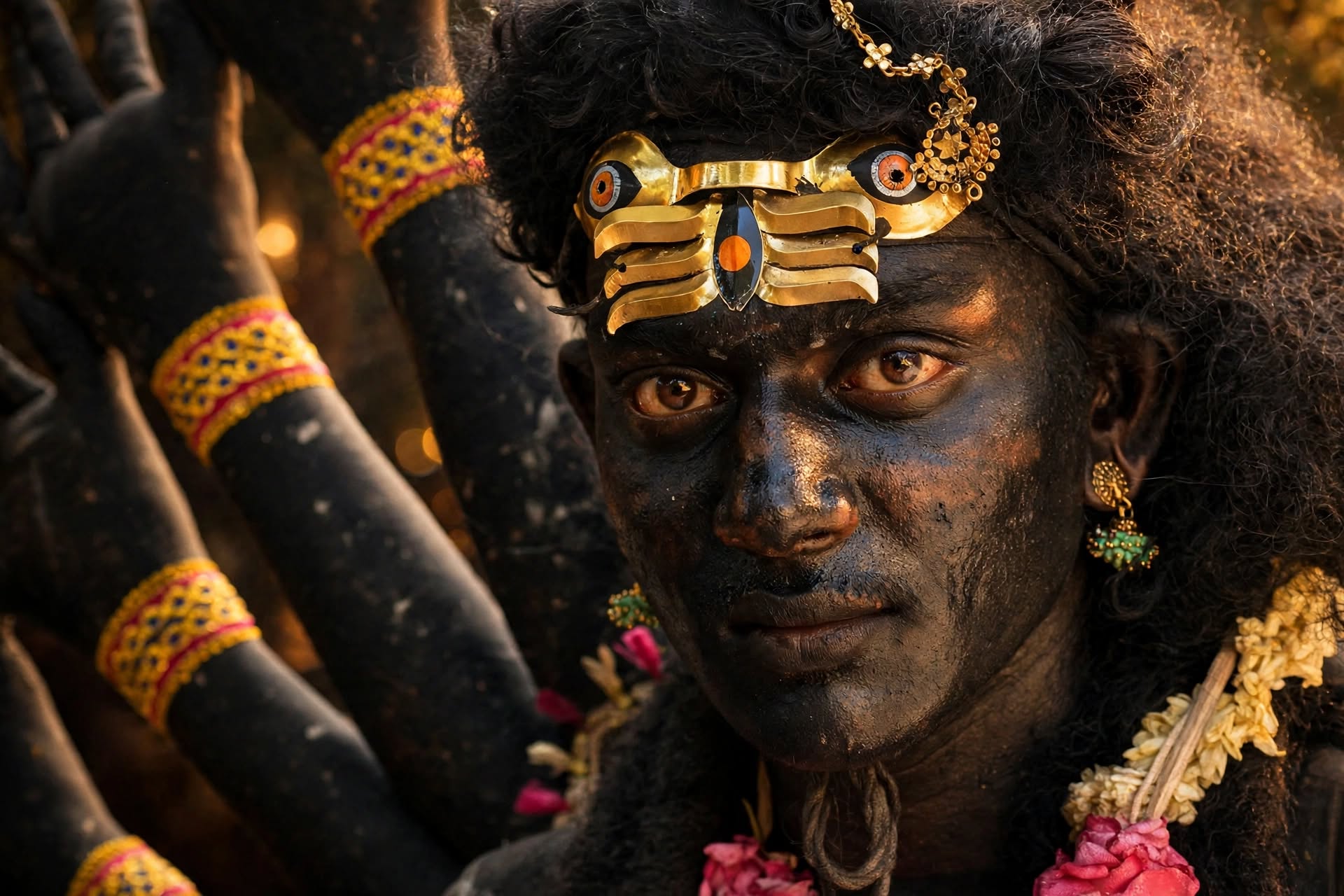
This is where Kulasai becomes fascinating. What you see here is called vesham. Taking vesham is not simply about wearing a costume or dressing up like a god.A devotee takes a vow to Mutharamman, observes a vratham and temporarily assumes another form as part of that devotion.
Some become Kali.Others appear as different gods and goddesses, kings, sadhus and various folk characters.The devotee may travel through different places in this form, accompanied by family or a group, with percussion called Tamate/Parai before finally reaching Kulasai.
So when you see hundreds of elaborately painted people walking through the lanes around the temple, you aren’t watching a fancy-dress procession.You are watching people fulfil their vows.
And what about those frightening skull costumes?
If this is your first visit to Kulasai, some of the Kali veshams can look intimidating.
Huge hair.
Black or dark body paint.
A long red tongue.
Weapons.
Multiple arms.
And sometimes necklaces or decorations made to look like skulls and severed heads.
These aren’t necessarily demons or evil spirits.
They are often Kali veshams.
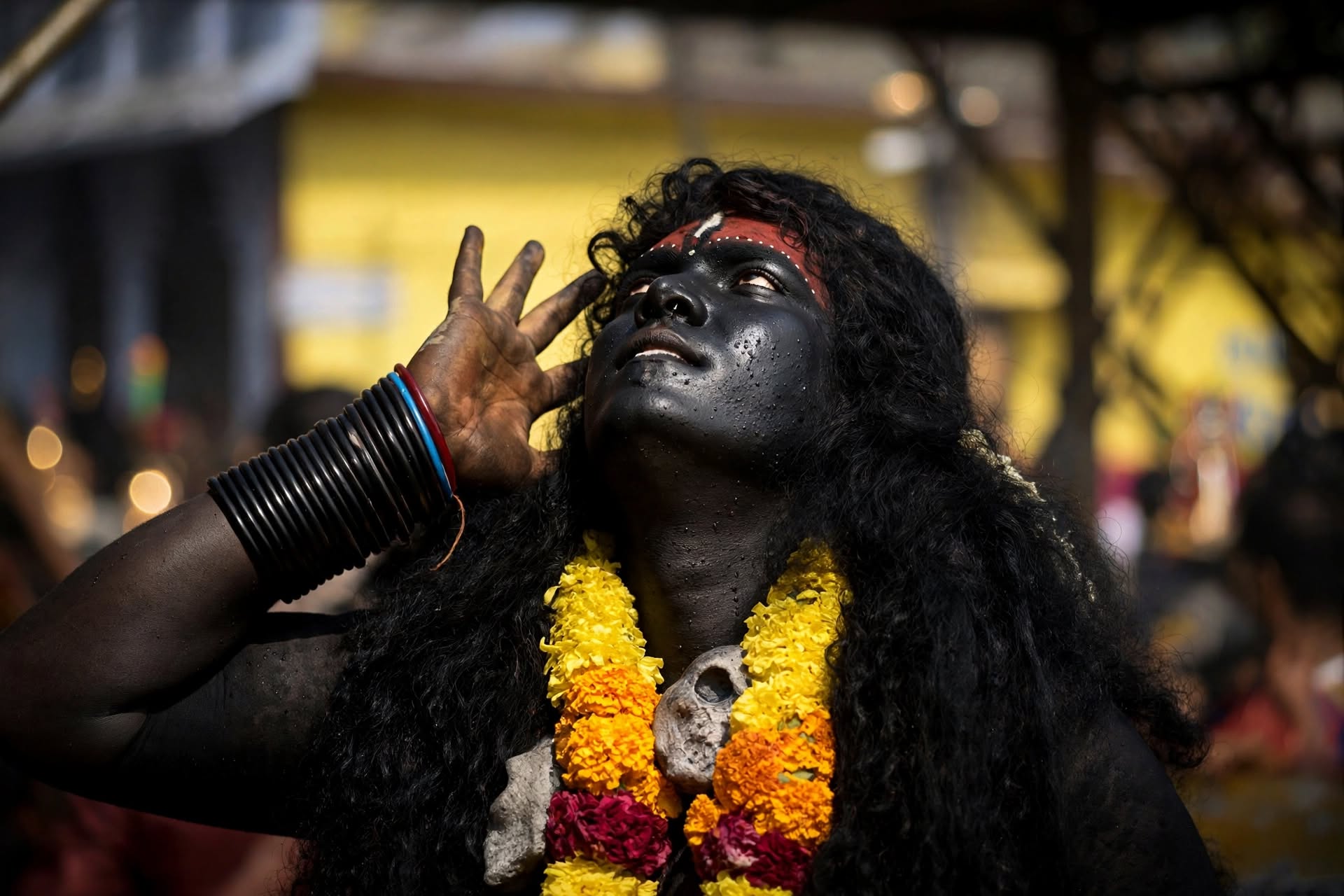
Kali’s appearance itself is fierce. The skulls, weapons and terrifying imagery represent her power over death, ego and evil.So at Kulasai, something that may initially look frightening often represents exactly the opposite. It is the form powerful enough to destroy what is frightening.
Vesham is really a temporary ritual identity
This is perhaps the most interesting way to understand Kulasai.
For those few days, the devotee steps away from his or her ordinary identity.
Think about it.
Someone who may ordinarily be a businessman, farmer, engineer, shopkeeper or office worker is now walking barefoot or through crowded streets, completely transformed and living publicly as the vesham that has been taken. The transformation itself becomes part of the devotion.
Vratham → Vesham → Offering → Kulasai → Shoora Samhara → Sea
And on the tenth day, all of this reaches its climax.
Shoora Samhara at Kulasai
On the tenth day, the Goddess comes out of the Mutharamman Temple for Shoora Samhara in a procession.Typically you wont find much opportunity to click in case you are photographer while Shoora samhara happens. Reason being this is a traditional ritual of temple where they enact killing of Mahishasura, with people allowed to see from good distance.
This is one of the most important moments of Kulasai Dasara.
During the ritual, the trishula comes out four times as the Goddess destroys four different forms:
Rakshasa. Hen. Bull. Lion.
Here temple priest will take the trishula from goddess hand and perform the head removal. And with Shoora Samhara, the Navaratri story reaches its conclusion.
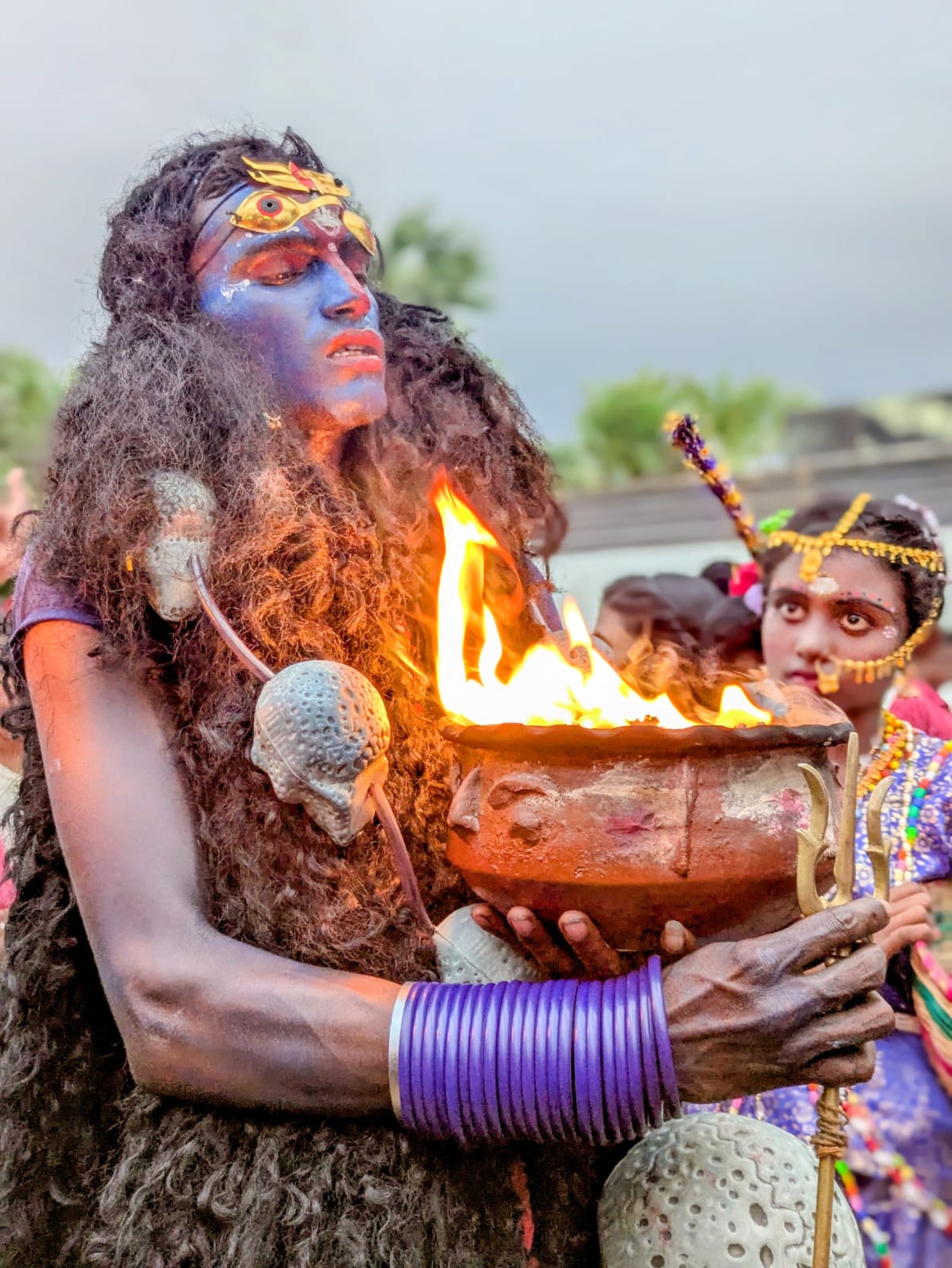
But for the Kali veshams, there is still one more journey to make.They head towards the sea.This is one of the most extraordinary sights at Kulasai.After Shoora Samhara, the Kali veshams begin moving towards the beach.
A kunda is created by the local administration in the beach area.Those carrying fire pots come here, drop the fire into the kunda and then continue walking towards the water. But you see that happening starting from mid day of dashami. So in case you have a bus on evening of Vijaya dashami and cant make it to Shoora samhara, you still get to see 100s of people closing their ritual in beach and near kunda
How to experience Kulasai Dasara from Bengaluru
If you are travelling from Bengaluru, reaching Kulasai is surprisingly straightforward. There are direct overnight buses from Bengaluru to Tiruchendur, including operators such as RP Tours and HyBus. Some services leave Kalasipalya at around 7 PM and reach Tiruchendur at approximately 8 AM the following morning.
Stay in Tiruchendur
Tiruchendur has hotels and makes a practical base for visiting Kulasai. But one must book early. Kulasai receives crowds running into lakhs during Dasara, particularly towards the final days of the festival.Rooms can become difficult to find if you leave the booking until the last minute.
Tiruchendur to Kulasai
From Tiruchendur, buses towards Kulasai are extremely frequent during the festival period, roughly every few minutes at peak festival time and operating through much of the day and night.The journey takes approximately 45 minutes, although festival traffic can obviously change that.
And once you reach Kulasai, be prepared for one thing: Walking. A lot of walking.
Temple side or beach side?
Once you arrive around the Kulasai bus area, the experience broadly divides in two directions. One towards the Mutharamman Temple. The other towards the beach. You should experience both.
Start around the temple
During the last two or three days of Dasara, the lanes surrounding Mutharamman Temple are filled with veshams.This is probably where you begin to understand the real scale of Kulasai. One group passes. Then another. Then another. Kali after Kali after Kali. Sometimes you may see close to tens of Kali veshams, moving together with their groups.
Alongside them are people dressed as kings, Hanumans, other gods and different characters.For photography, don’t concentrate only on the elaborate Kali portraits. Watch the groups accompanying them. Watch Kali walking through an ordinary village lane. Watch the expressions, rituals and little moments happening near temple. Then one can capture great shots in beach where you will find most of Indian content creators with veshams standing in beach with water till knee. That is where some of Kulasai’s best stories are found. But don’t underestimate the distance. Depending on where vehicles and buses are being stopped, you may need to walk at least 1.5 kilometres to reach the active beach area.
As the day progresses, more and more Kali veshams start arriving towards the beach. This is where you can witness the transition from the crowded streets to the final ritual journey towards the sea.If you enjoy photography, the beach and the lanes around Mutharamman Temple are probably the two areas where you will spend most of your time.
Food at Kulasai
Kulasai is a small village. It doesnt function like a regular tourist destination. You will not find many conventional restaurants immediately around Mutharamman Temple. However, during Dasara, a large mela-like exhibition atmosphere develops, with temporary stalls where you can find food and refreshments. So you can manage food there, but don’t go expecting a normal restaurant experience.
Dont Carry water, You get packaged ones in many pop up shops at Kulasai.
One thing that can spoil your plan: Rain
Rain is probably the biggest foul play that can happen during the visit.With lakhs of people around and very limited places to quickly take shelter, even a sudden shower can make things difficult.Carry a small three-fold umbrella. It hardly takes up space in your bag and is easy enough to carry throughout the day.
Comfortable footwear, drinking water(for sustainability cause) and a three-fold umbrella are probably three of the most useful things you can carry to Kulasai.
While staying in Tiruchendur…
Don’t forget that Tiruchendur itself has one of Tamil Nadu’s famous Murugan temples, the Tiruchendur Subramanya Temple. During the Kulasai period, expect huge crowds here too. A ₹100 darshan ticket can still take around 2 to 3 hours during this period. The free darshan queue can take roughly twice as long on particularly crowded days around Kulasai Dasara. So don’t plan Tiruchendur Temple as a quick one-hour stop before catching your bus. Keep sufficient time for it.
Why Kulasai is different
It is very easy to look at photographs from Kulasai and describe it as:”Thousands of people dress like Kali during Dasara.” But that description misses almost everything. Behind the paint is a vow. Behind the costume is a vesham. Behind the frightening Kali imagery is Shakti. Behind thousands of people walking towards the beach is a ritual journey that began days earlier. And behind everything is the story of the Goddess who grows through the nine days of Navaratri before destroying Mahishasura on the tenth.
At most festivals, we stand in the crowd and watch the story. At Kulasai, the crowd itself becomes part of the story. That is what makes Kulasai Dasara extraordinary.

Kulasai Dasara is not just a religious event; it’s a celebration of art, culture, and community. The entire village comes alive with music, dance, and drama, depicting scenes from the Ramayana and Mahabharata. As one of the most colorful events to be captured in India, it attracts thousands of pilgrims and tourists from around the world, eager to witness this spectacular display of faith and tradition.


If you’re traveling to India during October 2027, Travebrate, India’s leading and most unique travel planner, ensures you never miss out on such cultural marvels. We track close to 300 festivals and events across India, offering exclusive experiences beyond the ordinary. While we don’t book hotels or flights, we concentrate on building personalized itineraries that cater to your interests and dates. Reach out to us, and let us plan your unforgettable journey to Kulasai Dasara, where tradition meets celebration, and every moment is a testament to the enduring spirit of the community.
Join us in October 2027 for an unforgettable experience at Kulasai Dasara, and immerse yourself in the colors and cultures of India.
Interested
Hi Albin, Could you please send email to harshitha@travebrate.com, so that we can discuss.