

Step into India’s Living Epic: Why Ramnagar Ramleela Is a Must in Your Varanasi Itinerary
Looking to experience India’s rich culture in a way that goes beyond sightseeing? If you’re planning a trip to Varanasi in September or October, Travebrate highly recommends immersing yourself in the legendary Ramnagar Ramleela, a spectacle unlike any other festival in the world.
When is Ramnagar Ramleela in 2026?
Ramnagar Ramleela 2026 runs for 31 evenings, from Friday 25 September to Sunday 25 October 2026. The fall of Ravana, the night most visitors travel for, is enacted on Tuesday 20 October 2026, and the cycle closes with Rama’s coronation on 24 October and the final leela on 25 October.
Ramnagar Ramleela 2026: the full 31 day schedule
The Ramleela at Ramnagar runs for 31 consecutive evenings, and each night covers a specific chapter of the Ramcharitmanas at a specific location in the town. If you are travelling for a particular episode, whether that is the wedding at Janakpur, the burning of Lanka, or the fall of Ravana, this is the night you need to be there. Below is the complete leela-wise schedule for 2026, as announced by the Shri Ramleela committee, Ramnagar, Kashi.
| Day | Date | Weekday | The leela of the evening |
|---|---|---|---|
| 1 | 25 Sep | Friday | The birth of Ravana, the Kshira Sagar tableau, the praise of the gods and the divine voice |
| 2 | 26 Sep | Saturday | The birth of Shri Rama and his brothers, Virat darshan, the Bal Leela, and the Ramleela puja |
| 3 | 27 Sep | Sunday | Vishwamitra’s arrival, the slaying of Tadaka, the redemption of Ahalya, the crossing of the Ganga, and the arrival in Mithila to meet King Janaka |
| 4 | 28 Sep | Monday | Janakpur darshan, the meeting with Ahalya, and the marriage |
| 5 | 29 Sep | Tuesday | The Dhanush Yagya, the breaking of the bow, and the exchange with Parashurama |
| 6 | 30 Sep | Wednesday | The wedding party sets out from Awadh, and the marriage at Janakpur |
| 7 | 1 Oct | Thursday | The wedding party takes leave of Janakpur, the parichhan at Awadh and the resting tableau |
| 8 | 2 Oct | Friday | Rajatilaka Shubharambha, the auspicious beginning of the coronation, and Kaushalya |
| 9 | 3 Oct | Saturday | Van gaman, the departure into exile, the meeting with Nishadraj, and Lakshmana’s counsel to Sita |
| 10 | 4 Oct | Sunday | The river crossings, the meeting with Bharadwaj, the crossing of the Yamuna, the villagers, Valmiki, the residence at Chitrakoot, Sumantra’s return to Ayodhya and Dasharatha |
| 11 | 5 Oct | Monday | Bharata’s return, the assembly, his journey to Chitrakoot, the meeting with Nishad, the crossing of the Ganga and the Bharadwaj ashram |
| 12 | 6 Oct | Tuesday | Bharata at Chitrakoot, the giving of the paduka, and Bharata darshan |
| 13 | 7 Oct | Wednesday | Vashistha’s assembly, and Janaka’s arrival at Chitrakoot |
| 14 | 8 Oct | Thursday | Bharata takes leave of Chitrakoot, returns to Ayodhya, and the meeting at Nandigram |
| 15 | 9 Oct | Friday | The meeting with Atri Muni, the slaying of Viradha, the encounters with the sages, and the counsel to settle at Panchavati |
| 16 | 10 Oct | Saturday | Surpanakha’s disfigurement, the slaying of Khara and Dushana, the abduction of Sita, and Jatayu’s fight with Ravana |
| 17 | 11 Oct | Sunday | The search for Sita, Shabari’s hospitality, the description of the forest and the mountain, and the meeting with Hanuman and Sugriva |
| 18 | 12 Oct | Monday | The slaying of Vali, and Hanuman’s entry into Lanka |
| 19 | 13 Oct | Tuesday | Hanuman finds Sita, the burning of Lanka, the coming of Vibhishana, and the crossing of the sea |
| 20 | 14 Oct | Wednesday | Rama marches to the sea with his army, the meeting with Vibhishana, and the building of the bridge, Setu Nirman |
| 21 | 15 Oct | Thursday | Rama and the army at the shore, the description of the forces, Suvela hill, and Angada’s mission |
| 22 | 16 Oct | Friday | The battle at the four gates, and the shakti that strikes Lakshmana |
| 23 | 17 Oct | Saturday | The battle and death of Kumbhakarna, and the battle of Meghanada with the nagapasha |
| 24 | 18 Oct | Sunday | The battle with Ravana |
| 25 | 19 Oct | Monday | The battle with Ravana continues, and Raghupati is beheld |
| 26 | 20 Oct | Tuesday | Ravana falls on the battlefield, and the victory of Shri Rama |
| 27 | 21 Oct | Wednesday | The coronation of Vibhishana, the reunion with Sita, and the praise of the gods |
| 28 | 22 Oct | Thursday | Rama sets out for Awadh, and the halt at the ashram |
| 29 | 23 Oct | Friday | The Bharat Milap, the reunion of Rama and Bharata |
| 30 | 24 Oct | Saturday | Rajyabhishek, the coronation of Shri Rama |
| 31 | 25 Oct | Sunday | Rama’s court and leisure, and the meeting with the Sanakadi sages |
The three nights most people travel for
- Tuesday 20 October, the fall of Ravana. The climax of the whole cycle, when Ravana is struck down on the battlefield and Rama’s victory is enacted. This is the single busiest night.
- Friday 23 October, the Bharat Milap. The reunion of Rama and Bharata, and for many people in Varanasi the most emotionally charged evening of the month.
- Saturday 24 October, the Rajyabhishek. The coronation of Rama, the formal resolution of the epic.
If you only have one evening in Varanasi, 20 October is the night. If you have several, the closing sequence from the 20th to the 24th carries the whole ending of the Ramayana across five consecutive evenings.
Why Ramnagar Ramleela Is Unique
Imagine an entire town transforming into the stage for one of humanity’s oldest stories. The Ramnagar Ramleela unfolds over 31 days, using Ramnagar’s real streets, forts, and ghats as locations for each scene. No spotlights, just lanterns and the Ganges breeze. Every evening, locals gather to become characters, singing and acting out the Ramayana as it’s been done for over two hundred years. The energy is contagious: children run beside kings, villages cheer on Hanuman, and dramatic battles light up the dusk.
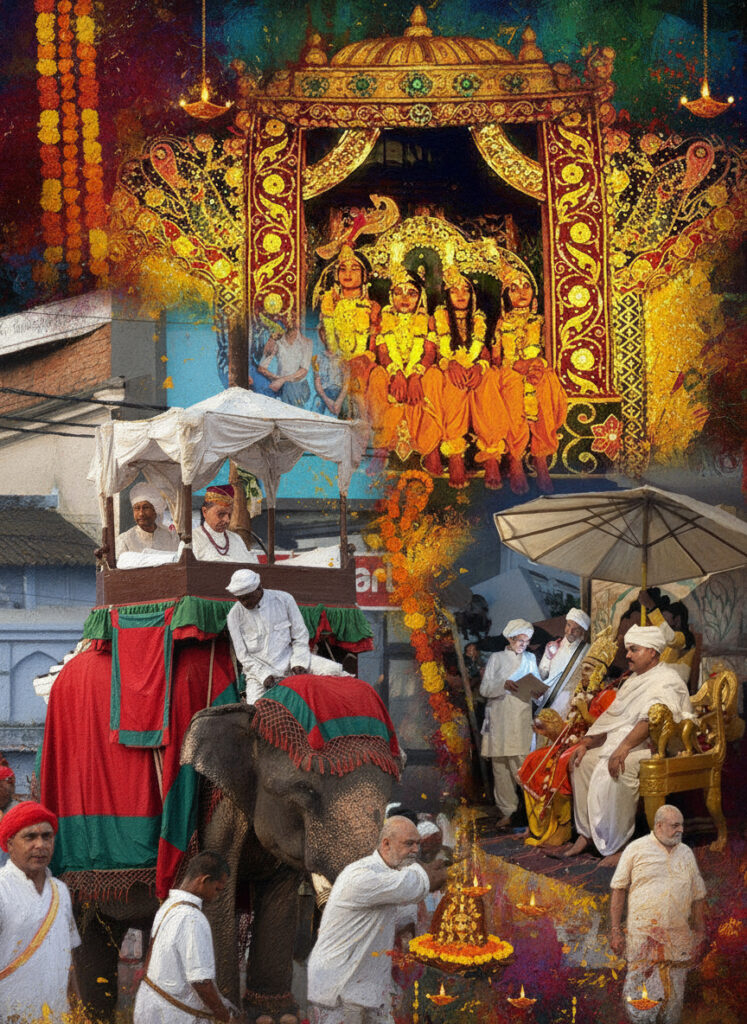
Not just a performance, Ramnagar’s Ramleela is a living tradition. It’s recognized by UNESCO for its authenticity and community spirit. You won’t just watch, you’ll feel swept up in the drama, devotion, and timelessness of Indian storytelling.
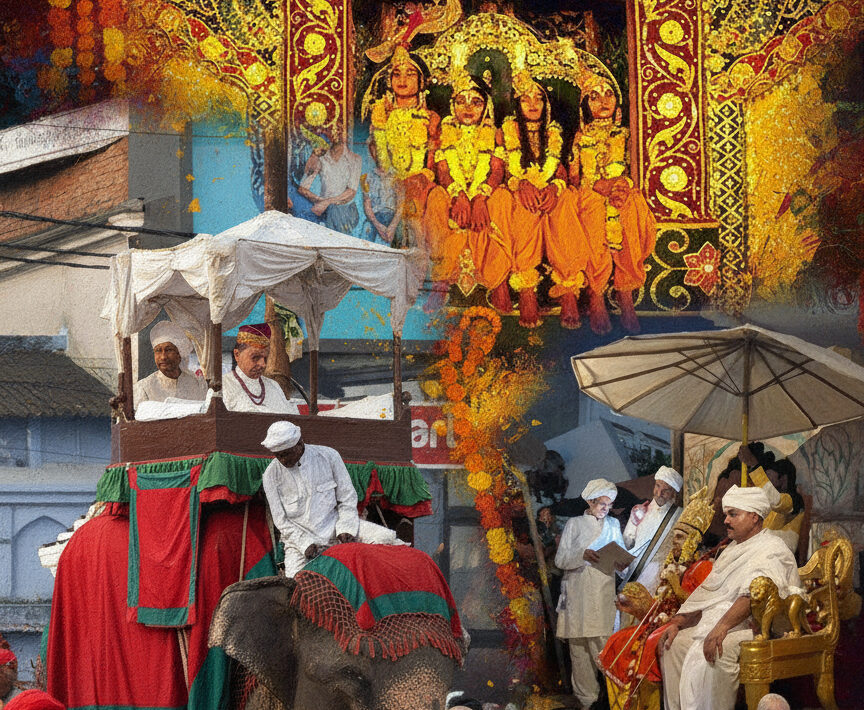
One of the unique traditions of Ramnagar Ramleela is the procession of elephants that adds majesty and cultural depth to the festivities. The royal descendants of Kashi Naresh arrive atop beautifully adorned elephants, symbolizing the royal auspices under which this tradition thrives. However, an interesting custom observed is that the king does not witness the death of Ravana, as a monarch, it is considered inappropriate to witness the death of another king. This respect for regal decorum adds a distinctive cultural nuance to the celebrations.
The Ramleela in Ramnagar rejects modern technology, relying solely on natural elements for ambiance. No electric lights or microphones are used; instead, flickering oil lamps and torches light the scenes, while the actors project their voices naturally throughout the town’s maze of historic streets. The entire area is divided into various zones that represent different parts of the Ramayana story, from Ayodhya to Lanka to Ashoka Vatika, each site bringing a chapter of the epic to life against authentic historic backdrops. Audiences follow the performers on a pilgrimage-like journey, moving from place to place as the story unfolds.
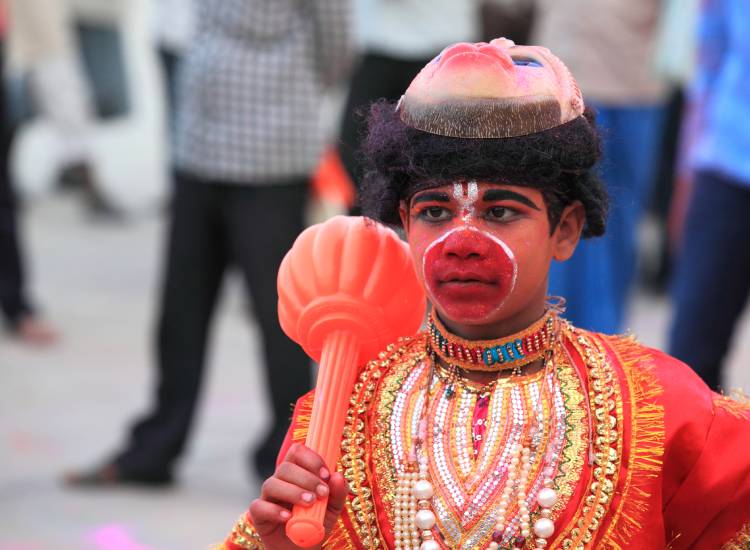
This living theatrical tradition is not just a performance but a deeply spiritual and communal observance that has been carried on for over 200 years. Actors, mostly boys aged 10 to 14, train months in advance and stay in character throughout the month, immersing fully in the role.
How Close Is Ramnagar to Varanasi?
Ramnagar is right next to Varanasi, barely 6 kilometers away. Just a quick drive or a short boat ride across the Ganga takes you straight from the hustle of the city to the heart of the festivities. This closeness means there’s no excuse to miss it, especially when paired with Varanasi’s world-famous Ganga aarti and temple trails.
Add Ramnagar Ramleela to Your Travebrate Itinerary
At Travebrate, we craft itineraries that aren’t just about bucket lists, they’re about living festivals. Here’s how to make the most of your trip during Ramleela season:
- Begin your day with a sunrise boat ride on the Ganga.
- Explore ancient temples and winding lanes through the afternoon.
- In the evening, head to Ramnagar for the Ramleela, strolling from one improvised stage to another as scenes shift across the town.
- Do not miss the closing nights, when the battle, the fall of Ravana and the coronation unfold across consecutive evenings.
- Sample festive street eats and mingle with local families for the truest sense of Indian hospitality.
Travebrate’s Ramayana Journey
We also offer a special Ramayana Itinerary for festival seekers: start in Ayodhya for Deepotsav, move on to Varanasi for iconic ghats and temple rituals, and time your visit for the full Ramnagar Ramleela experience. This route weaves together India’s spiritual history, vibrant processions, community feasts, and the awe of seeing the Ramayana come alive, scene by scene, town by town.
Discover More With the India Fest App
Want to make sure you never miss a festival on your India adventures? Download the India Fest app, a digital companion loaded with up-to-date festival dates, colorful event listings, and personally crafted Travebrate itineraries. With real-time alerts, photo galleries, and maps to the nearest celebration, this app ensures every trip is a festival-hopper’s dream.
Why Choose Travebrate?
At Travebrate, we believe in curating journeys that let curious travelers engage with India’s most authentic festivals and living heritage. By including Ramnagar Ramleela in your Varanasi trip, you’ll carry home not just memories, but a piece of India’s sacred storytelling tradition.
Plan with Travebrate for a journey where you don’t just visit, you become part of the epic.