

Ardh Kumbh 2027: How to Experience Haridwar’s Great Gathering — and Actually Understand What You’re Seeing
Haridwar, 14 January – 20 April 2027. Plan it with Travebrate.
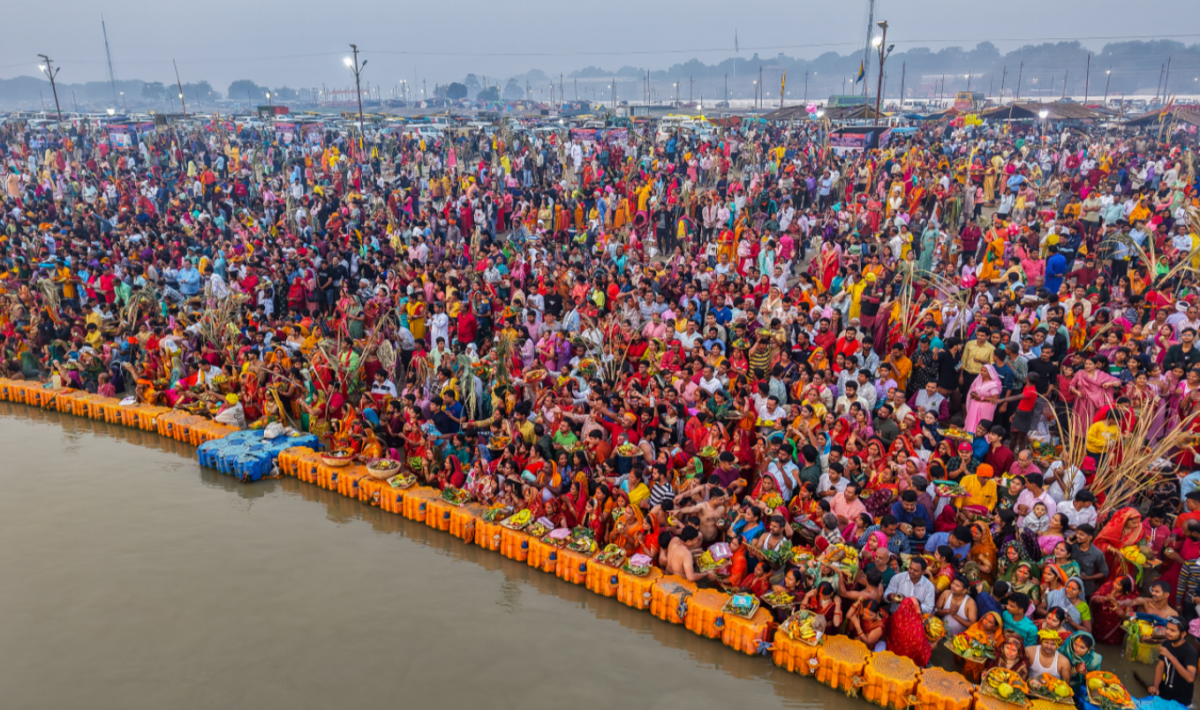
There is a moment, just before dawn at Har Ki Pauri, when the cold comes off the Ganga in a grey mist and the crowd goes quiet — and then the conch shells start. What follows is not a festival in any sense a Western calendar would recognise. It is a city of tents and saffron and woodsmoke that materialises on a riverbank, swells to hold a significant share of humanity, and then dissolves again, leaving only the water moving as it always has. This is the Kumbh. In 2027, after six years, it returns to Haridwar — and if you have ever thought about going, this is the one to go to.
Here is what it actually is, what to expect, and how to be there as a traveller rather than a tourist.
First, the thing itself: what is the Kumbh Mela?
The short version is mythological. When the gods and the demons churned the cosmic ocean for amrit, the nectar of immortality, a few drops fell to earth — at Haridwar, Prayagraj, Nashik and Ujjain. The Kumbh, which takes its name from the kumbh (pot) that carried the nectar, rotates between these four cities, and pilgrims gather at each in turn at the astrologically appointed hour to bathe in the river and, in doing so, to wash away a lifetime of sins. UNESCO calls it intangible cultural heritage. Most people who have stood in it call it something harder to name.
The longer version is that the Kumbh is the largest gathering of human beings on the planet, and it has been happening, in some form, for a very long time.
And the “Ardh” part?
Ardh means half. The full Kumbh comes to each city once every twelve years; the Ardh Kumbh falls at the midpoint, every six. The word “half” undersells it badly. Ritually, astrologically, spiritually, it is the real thing — the same thirteen akharas, the same processions, the same sanctified water. The 2027 Haridwar edition carries particular weight: it is the first full-throated gathering here since the pandemic-shadowed 2021 Kumbh, and the state has said openly it intends to stage it on the scale of a full Kumbh.
When is it? The dates that matter
The Ardh Kumbh 2027 runs from 14 January to 20 April 2027 — ninety-six days on the banks of the Ganga, anchored at Har Ki Pauri, the ghat where Vishnu is said to have left his footprint in the stone. Within that long window, certain days are charged with far more significance than others, and the crowds rise and fall accordingly.
| Date | Occasion | Significance / Snan Type |
|---|---|---|
| 14 January 2027 | Makar Sankranti | First Holy Snan (Opening Date) |
| 06 February 2027 | Mauni Amavasya | Major Holy Snan (Highest Crowds) |
| 11 February 2027 | Vasant Panchami | Holy Bathing Day |
| 20 February 2027 | Magh Purnima | Holy Bathing Day |
| 06 March 2027 | Mahashivratri | 1st Amrit Snan (Royal Bath) |
| 08 March 2027 | Phalgun Amavasya | 2nd Amrit Snan (Somvati Amavasya) |
| 07 April 2027 | Nav Samvatsar | Hindu New Year Snan |
| 14 April 2027 | Mesh Sankranti | 3rd Amrit Snan (Baisakhi — Main Event) |
| 15 April 2027 | Ram Navami | Holy Bathing Day |
| 20 April 2027 | Chaitra Purnima | Final Snan (Closing Date) |
The three Amrit Snans — 6 March, 8 March and 14 April — are the days to plan around, with the Baisakhi Snan on 14 April the undisputed peak. If you want the great processions at their fullest, those are your dates. If you want the river to yourself, or something closer to it, the quieter bathing days in between reward you with space to breathe.
“Shahi Snan” is now “Amrit Snan” — and why that matters
If you have read about previous Kumbhs, you will have met the term Shahi Snan, the “royal bath.” For 2027 the Uttarakhand government, together with the thirteen akharas, has officially retired it in favour of Amrit Snan, the “nectar bath.” The reasoning is linguistic and cultural: Shahi is a Persian-rooted word for “royal,” while Amrit is Sanskrit, and reaches back to the very legend of the nectar that fell at Har Ki Pauri. The name is new; the ritual is ancient and untouched.
On these days the akharas bathe first, and the bathing is a spectacle in the truest sense — naga sadhus grey with ash, Mahamandaleshwars borne on garlanded chariots, the whole procession moving toward the water in a slow saffron tide. Only once the saints have bathed do the rest follow, for it is believed their dip charges the river itself.
How many people, really?
This is where numbers stop meaning much and start becoming weather. For perspective: the 2025 Maha Kumbh at Prayagraj drew an almost unimaginable 45 crore people over its course. For Haridwar in 2027, authorities are expecting on the order of 17 crore devotees across the ninety-six days, with the heaviest concentrations on the Amrit Snan dates and above all on 14 April.
What that translates to on the ground is a temporary metropolis: thirty-two sectors, each with its own hospitals, police posts and water points, knitted together by what is being billed as India’s first “Digital Kumbh” — AI crowd monitoring, e-passes, digital pilgrim IDs, and a wall of CCTV feeding a central command centre. It is, in the most literal sense, a city built to be unbuilt.
Why go
Because there is genuinely nothing else like it, and because the next one is six years away. But also for the smaller things the headlines miss: the old man who has saved for a decade to stand in this water once; the akhara camps where a stranger will press hot chai into your hands and a sadhu will tell you, unprompted, the entire cosmology of the universe; the Ganga Aarti at dusk, every dusk, when the river fills with floating lamps and the whole bank sings. You can come as a believer chasing moksha or as a sceptic chasing a story. The Kumbh does not much mind which. It tends to rearrange something in you either way.
And Haridwar is a fine base for more. Rishikesh and its riverside cafés are an hour off; the Panch Tirth circuit — Har Ki Pauri, Kushavart, Kankhal, Mansa Devi, Chandi Devi — gives shape to a longer stay; Rajaji National Park is close enough for a day away from the crowds.
For photographers
If you shoot, this is one of the great subjects on earth — and one of the most demanding. The processions give you the obvious epic: ash-smeared nagas, chariots, a river of humanity in motion. But the quieter frames are often the ones that last — the aarti flames reflected in an old woman’s glasses, the geometry of a thousand brass pots, a single sadhu’s hands. The light at Har Ki Pauri at dawn and dusk does a great deal of the work for you.
Two things to hold onto. First, ask before you photograph sadhus or private rituals — a nod costs nothing and changes everything, and the Amrit Snan in particular deserves to be watched before it is shot. Second, and this is not negotiable: leave the drone at home. The airspace over the mela is controlled and patrolled, drones are operated by the authorities themselves for crowd safety, and an unauthorised one will earn you the wrong kind of attention very quickly. Anything aerial or professional requires official permission, sorted long in advance. The Kumbh, in any case, is an event best told from inside the crowd, not above it.
The one logistical truth: Dehradun is the bottleneck
Here is the practical thing nobody tells you until it is too late. The nearest airport is Dehradun’s Jolly Grant — a small airport feeding an event of impossible scale. Seats vanish and fares climb steeply as the snan dates approach. More flights than usual are expected to be laid on for the Kumbh, which helps, but capacity is finite, so the rule is simple and absolute: book your flights as early as you possibly can, especially around the 14 April peak. The same goes for trains, road transport and any bed in or near Haridwar — the corridors into the city fill months ahead. Go early, go patient, and the journey becomes part of the pilgrimage instead of a fight.
What Travebrate actually does (and doesn’t)
Let’s be clear about this, because it matters. Travebrate does not book your hotels or your flights. What we do is the part that’s genuinely hard to do well: we plan your itinerary, and we make sure you understand it.
You receive a clear, detailed itinerary as a PDF, and we walk you through it over virtual calls — partly so nothing gets lost, and partly so you’re dealing with real people rather than the spam and noise that surrounds an event this big. From there, we keep you notified with updates as dates, crowds and arrangements firm up, and we tell you what to expect before you’re standing in it.
The difference, though, is in the context. We tell you the story behind what you’re watching — why the akharas enter in the order they do, what the ash and the matted hair mean, the tales of the more remarkable naga sadhus you might cross paths with. We point you toward the photo-walk routes and tours worth your morning, and the guides worth trusting. And we answer the real questions travellers actually ask — Is a non-Hindu permitted to take the dip? Which ghat, which hour, which day for what I want? — clearly, in your itinerary, before you go.
In short: the beds and the flights are yours to book. The understanding is ours to give.
Plan with Travebrate
Event: Ardh Kumbh Mela 2027
Where: Haridwar, Uttarakhand — Har Ki Pauri and the Ganga ghats
When: 14 January – 20 April 2027
The three Amrit Snans: 6 March, 8 March and 14 April 2027 (14 April is the peak)
Nearest airport: Dehradun (Jolly Grant) — book early
Drones: Not permitted
Tell us what you’re after — a single Amrit Snan, the nightly aarti, a photography-led few days, a first-timer’s gentle introduction — and we’ll build the itinerary around it, explain it properly, and keep you in the loop right up to the riverbank.
The water will be cold. The crowd will be larger than anything you have known. And somewhere in all of it, something tends to make sense that did not before. Come prepared, come patient, come early.
Plan your Ardh Kumbh 2027 with Travebrate.