

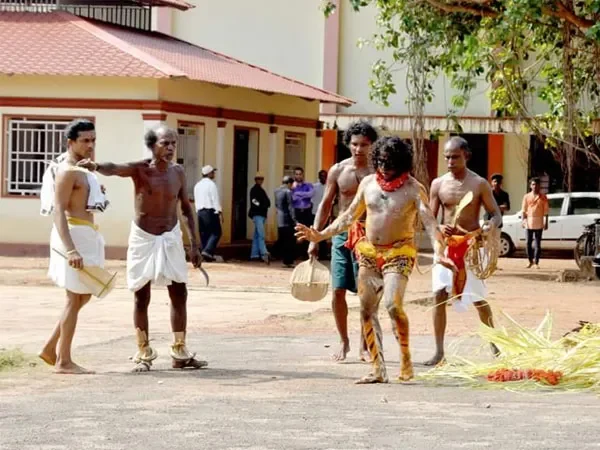
The Pili Kola of Kaup
Coastal Karnataka, known as Parashurama Srishti, is a land where the lines between the human, the divine, and the wild blur into a beauty of rituals. While many are familiar with the vibrant Daiva Aradhane rituals, there is a ceremony in Udupi district that stands out for its raw energy and primal devotion: the Kaup Pili (Tiger) Kola.
Note from Travebrate:
At Travebrate, we love documenting the soul of Coastal Karnataka. However, please note that we do not plan itineraries for this specific event i.e. pilikola. This story is documented here purely to showcase the incredible cultural uniqueness of Tulunadu.
The Legend: From Royal Games to Godly Ritual
The history of the Pili Kola is as fierce as the ritual itself. Legend has it that the Bhairarasu kings of Karkala once kept a tiger in a palace cage. In those days, the King organized gladiatorial fights where it was a brutal battle of life and death—either the tiger had to die, or the human fighter had to perish.
As the era of kings passed, the tiger was handed over to the Muggera community of Kaup. Over time, it was realized that this tiger possessed a divine essence (Daivansha), leading to the transition from a “game” to a sacred ritual. Thus, the tiger was revered as Pili-Chandi Daiva, a guardian spirit of the land.
Another legend has that Bhaira Arasu, the King of Karkala, kept a tiger in a cage within his palace. Over time, managing the wild beast became difficult, and the King sought permission from Goddess Mariyamma of Kaup to release it into the forest. That night, the Goddess appeared in the King’s dream, revealing that the tiger was no ordinary animal but an incarnation of a Daiva (spirit). She instructed him to build a shrine on the right side of her temple; thus, the tiger was revered as Pili-Chandi Daiva.
The Ritual: 5 Hours of Pure Adrenaline
Held once every two years, the Pili Kola is a sight to behold. The next occurrence is slated for May 16, 2026, in the surroundings of the Kaup Marigudi Temple.
- The Awakening: After two hours of intricate “Bannagarike” (face painting) and sacred procedures, the Pili-Chandi Daiva emerges from a cage with an explosive roar.
- The Sacrifice: The Daiva circumambulates the Brahma Gunda three times, climbs the Banta Stambha (a tall pillar), and accepts a live chicken sacrifice before beginning the village visit.
- The Hunt: For the next five hours, the “Tiger” roams the temple vicinity. This is not a performance; it is a literal hunt. The core objective of the crowd is to ensure the tiger does not touch anyone.
The “Impact”: A High-Stakes Chase
In this ritual, being “touched” by the Daiva is not seen as a traditional blessing—it is a fearful “impact.”
The Stakes of the Hunt
If the Tiger (Patri) fails to touch anyone during the five-hour hunt, the negative impact falls upon him. However, if he manages to touch a devotee, that individual carries the “impact.”
Historically, the Tiger has caught people multiple times; the most recent instance was in 2024. Once the Daiva successfully hunts a person, he returns to the Mariyamma temple to conclude the Kola.
A Unique “Divine Court”
The day before the Pili Kola features Police Daiva Kola in Kapu. As per a legend, pilichandi on the way to dip, saw a Panchayat happening where Bankinayaka and the Patela settle cases in presence of police involving characters like Balayi Mara(person selling avalakki) and Thiga Mara(Honey Vendor), who are accused of not paying taxes. Looking at the way they are working towards maintaining law of land, he converts them as Daiva.
- Police & Patela Daivas: Representing the law of the land, these spirits act as judge and enforcer.
- The Case: A court (Panchayat) where Bankinayaka and the Patela settle cases involving characters like Balayi Mara and Thiga Mara, who are accused of not paying taxes.
Who Visits?
While foreigners and photographers do visit, this event is primarily for the devotees of Tulunadu. It typically draws a crowd of over 2,000 people. It is not a tourist spectacle; it is a visceral, high-tension experience of faith where the crowd must stay alert to avoid being part of the “hunt.”
Travebrate Insight: The Kaup Pili Kola is a reminder that in Coastal Karnataka, nature and spirit are inextricably linked. It is a raw manifestation of the Tulu spirit that must be seen to be believed.