

Travebrate · Festival Guide
When Is Bama Kali in Shantipur? The Dance of Goddess Kali
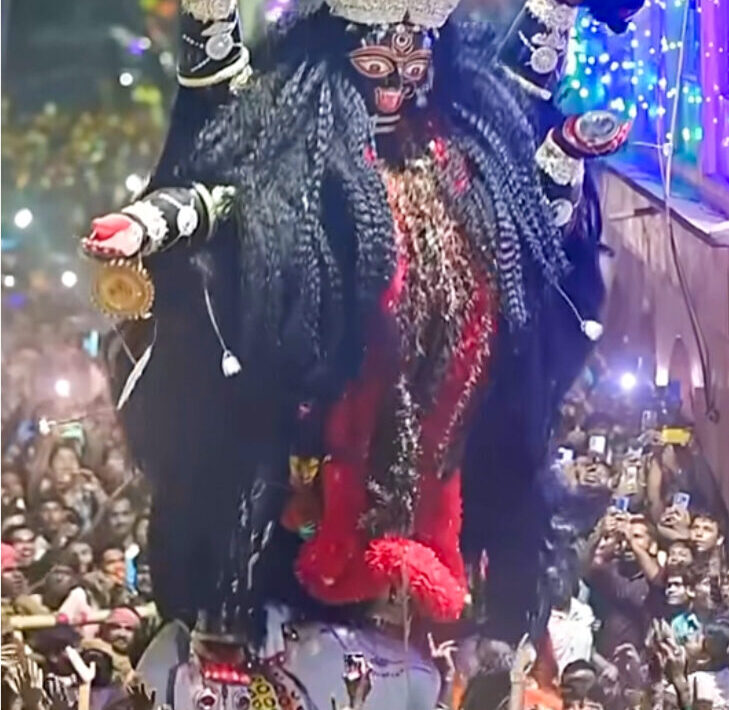
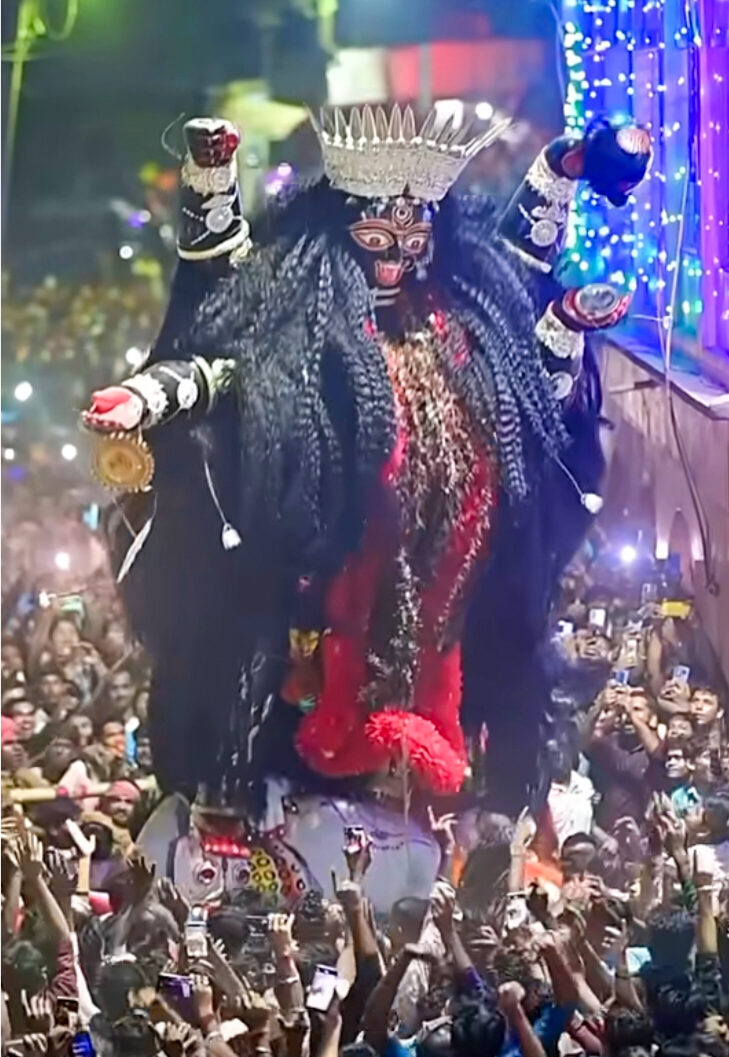
Around forty feet of clay carried on the shoulders of a town, and the devotees who lift her say she becomes as light as pith.
Kali Puja in Bengal is a night of scale and noise. In the small weaving town of Shantipur in Nadia district, it is something else. Here the goddess is Bama Kali, and everything about her worship runs against expectation. She refuses the offerings most Kali temples make. She asked for no electric lights. And when the time comes to carry her to the water, the people who lift her insist she stops being heavy.
What makes her Bama Kali
The difference is one foot, and it changes everything.
In the familiar Dakshina Kali form seen across Bengal, the goddess stands with her right foot on the chest of Lord Shiva. Bama Kali stands with her left. Bama means left, and the reversal marks her as a distinct and considerably more intense manifestation. In tantric terms it is not a decorative variation. It is a different presence altogether, and the worship reflects that.
She is also known locally as Bombat Kali, which is the more recent of her two names. Both refer to the same goddess.
When is Bama Kali puja held?
The puja falls on Kali Puja, the night of Amavasya, the new moon of the month of Kartik. It is the same night Bengal worships Kali across the state, and the same night much of India lights lamps for Diwali. In 2026, Kali Puja falls on Sunday, 8 November, and the Bama Kali procession and immersion follow on Monday, 9 November.
At Shantipur it runs across three days:
Sat 7 November
Arrival
The night before. The idol is brought and installed, and the town begins to gather around her.
Sun 8 November
The puja
Kali Puja, the night of Amavasya. She is worshipped through the day and the night, by lamp and by offering.
Mon 9 November
Bhasan
The procession and immersion, and the dance that people travel to Shantipur to see.
Three days that carry a year of devotion. Because Kali Puja follows the lunar calendar the dates move every year, so if you are planning a trip around it for a later year, ask us and we will confirm them for your travel dates.
How she was found
The story begins a few hundred years ago with a sadhu named Kamalanand Thakur, who spent his life in meditation on that ground, longing for a vision of the goddess.
It came on a night of thunder and heavy rain. A brilliant light appeared, and Kali revealed herself to him. She told him she was already there, enshrined beneath the ground of that land, which his long penance had sanctified. She asked him to bring her into the light, so that she could take away the suffering of her devotees.
When he told the villagers, they did not believe him. So he took them to the spot and they began to dig. What came out of the earth was a Shivalinga, and a black stone carrying the form of Kali, etched into it naturally, made by nobody. A temple was raised on the site. At the first aarti, it is said, a light came out of the temple that everyone present saw, and Shantipur understood what it had been given.
1969, and the night she gave new instructions
The worship as Shantipur practises it today was set in 1969, and not by a committee.
The goddess is said to have entered a devotee named Yamuna, and to have spoken through her in a state of possession. She made her presence known, and she made her wishes plain. She was not satisfied with how things had been done.
- She refused animal sacrifice, which is offered to Kali at many Bengal temples.
- She refused alcohol, which had been part of the tantric ritual until then.
- She refused electric lights.
In place of all of it she asked for one thing, which was pure devotion. And she named the Choudhury family to carry the worship forward.
What is striking is how completely the town accepted it. A goddess with a centuries-old temple revised her own worship inside living memory, and Shantipur simply did as she asked, and has done ever since.
What the worship actually looks like
There is no grandeur here in the way Bengal usually understands grandeur at Kali Puja. No blazing lighting, no competitive display. The offerings are modest and exact, because they were specified rather than chosen: incense, luchi, suji, and her favourite, sandesh, the Bengali sweet.
Against that restraint stands the idol itself, rising around forty feet. Nothing about her is small. It is only the ritual around her that is quiet.
The dance at the immersion
This is what people come for.
When the time comes for Bhasan, the immersion, devotees lift that towering idol and carry her through Shantipur in procession. Anyone who has done the lifting will tell you the same thing, and they tell it plainly rather than as a claim: at some point she stops weighing what she should. She becomes light, they say, as light as a piece of sola, the pith used to make ornaments for the gods.
The belief is straightforward. In those moments the goddess is dancing, and what the crowd is carrying is not really the weight of the clay. The procession is not a solemn farewell. It is loud, fast, joyful, hundreds of people moving under her while she rises and falls above them. A departure that looks like a celebration.
The Sohi, her friends among the deities
Bama Kali is not the only powerful presence in Shantipur. She has Sohi, friends among the local deities, and Agameshwari Mata is among them.
The friendship comes with a rule that the town observes seriously. During the processions, the idols of these deities are kept apart. They are not allowed to come face to face. The belief is that a direct encounter between presences of that magnitude would be more than the occasion could hold, and possibly more than the town could hold. So the routes are worked out in advance, quietly, and the meeting never happens. Nobody treats this as a formality.
Keeping it exactly as she asked
Shantipur guards this tradition with unusual care, and the clearest sign of it is what happens when things go wrong.
When the family of the Pal Moshai, the traditional idol-makers, has run into difficulty, the community has not simply found someone else and carried on. They work to keep the original methods alive instead. The reasoning is not sentimental. These are not customs that grew by habit and can therefore be adjusted. They are instructions, given directly, and the town treats changing them as not being within its authority.
Ask around and the stories of her presence come easily. Quantities of milk for the offerings that shift when nobody has touched them. Small physical things nobody can account for. To Shantipur these are not tales. They are confirmations, offered without much drama, of something the town already takes as settled. She is here. She is living. She is watching.
If you want to be there
Shantipur sits in Nadia district in West Bengal, a few hours from Kolkata and reachable by train on the Sealdah line. It is better known to most people for its weavers and its Shantipuri sarees than for this, which is part of why the Bama Kali nights still belong to the town rather than to visitors.
Come, by all means. But come the way she asked to be met. The goddess of Shantipur made her terms clear from the beginning and they have not changed: she does not want wealth and she does not want spectacle. What she accepts is bhakti, devotion, and a prayer offered honestly. Bring that and you will be received well. Bring a camera and nothing else and you will have missed what you travelled for.
Practical notes: the immersion procession is crowded and moves fast, so keep to the edges and follow local guidance. This is an active religious observance rather than a staged event, so ask before photographing people at worship, and dress as you would for any temple.
Why plan Bama Kali with Travebrate
Kali Puja moves every year with the new moon, and the part most travellers actually want to see, the immersion dance, is not on the puja night at all but the day after, so arriving on the obvious date and leaving the next morning means missing it entirely. Shantipur is a working town rather than a festival destination, which means beds are ordinary and few and the useful information is held by people rather than websites. This is precisely the work we do. We track India’s festival calendar ourselves, including the festivals nobody else bothers to track, and we publish those dates free for anyone to use, client or not. When you plan with us we take your travel dates, tell you which festivals you will genuinely cross paths with, and build the journey around the ones that matter to you, with the timings, the etiquette and the story behind each ritual so that you understand what you are standing in front of. We do not book flights or hotels and we take no commission from anyone, so nothing we recommend is shaped by what pays us. One personalised itinerary is a flat USD 100, and you book the trip your own way. Content creators, do reach out to us for special pricing.
Plan a Kali Puja journey through Bengal
Tell us your travel dates and we will tell you which of India’s festivals you will cross paths with, and build your itinerary around the ones that move you.
Plan my trip on WhatsAppPlan your India tripCustom India itineraries from USD 100 · We craft the experience; you book the trip your way.