

Travebrate · Festival Guide
When Is Koovagam Festival? India’s Largest Transgender Gathering
For one night each year, in a small Tamil Nadu village, thousands become the brides of a god. By the next morning, they are his widows.
There is no festival in India quite like Koovagam. For eighteen days each year, a quiet village in Tamil Nadu becomes the spiritual centre of the country’s transgender community. Thirunangai, Aravani and Kinnar from across India, and from as far as Malaysia, Singapore, the United Kingdom and Australia, travel here to take part in a ritual that is nearly as old as the epic it comes from. They marry a god at night and mourn him at dawn.
When is Koovagam festival in 2027?
The central ritual of Koovagam falls on Tuesday, 20 April 2027, at the Koothandavar Temple in Koovagam village, Tamil Nadu.
The date follows a clear rule. Koovagam is held on the Tuesday before Chithirai Pournami, the full moon of the Tamil month of Chithirai, which falls in April or May. Because the full moon shifts each year, so does the festival, but the Tuesday anchor holds. The wider Koothandavar festival runs for around eighteen days in total, building toward that Tuesday and continuing after it.
For travellers, the three days at the heart of it matter most:
Monday 19 April
The pageant
Miss Koovagam, the celebrated beauty and talent pageant, along with cultural competitions and community events.
Tuesday 20 April
The marriage
The main day. Priests tie the thali, and thousands become the brides of Lord Aravan for a single night.
Wednesday 21 April
The mourning
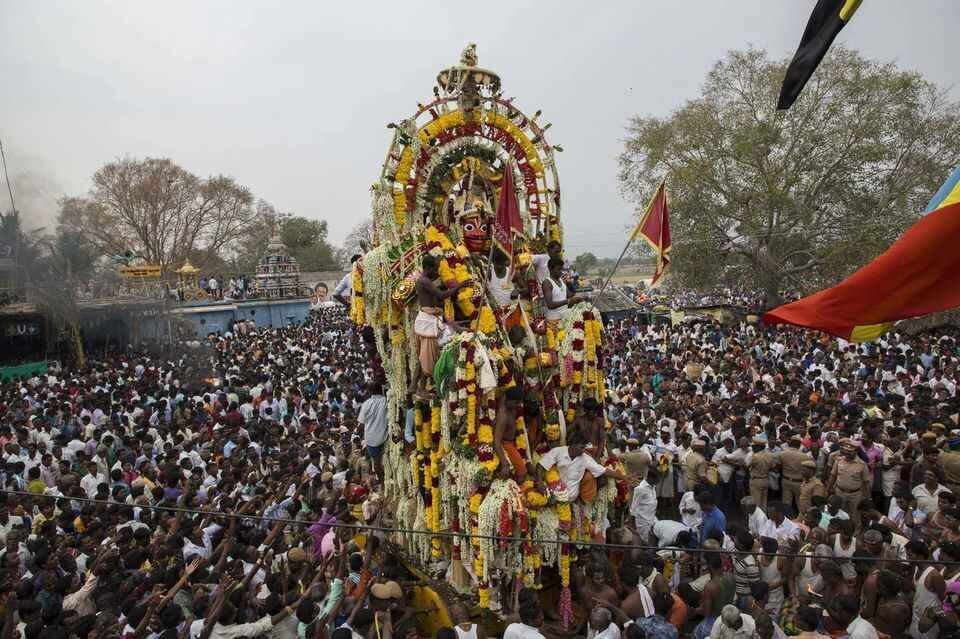
The chariot carries Aravan to his sacrifice. Bangles are broken, the thali removed, kumkum wiped away.
The story behind it: Aravan and Mohini
The festival rests on an episode from the Mahabharata. Aravan, worshipped here as Koothandavar, was the son of Arjuna. Before the great war at Kurukshetra, he offered himself as a sacrifice so that the Pandavas might win. He asked for one thing first: that he should not die unmarried, but know what it is to be a husband for at least one night.
No woman would marry a man certain to die the next day and leave her a widow. So Lord Krishna took the form of Mohini, a woman, and married Aravan himself. The following morning Aravan gave his life, and Mohini grieved for him as a widow grieves.
For the transgender community, this is not a distant myth. Krishna becoming Mohini is a divine affirmation of their own identity, written into scripture. In taking the role of Mohini each year, they are not performing a story. They are claiming a place in it. As one participant put it, Lord Aravan is their deity, and marrying him is a profound spiritual honour.
What happens across the eighteen days
Miss Koovagam and the days of gathering
In the run-up to the main ritual, the village and nearby Villupuram fill with events. The best known is the Miss Koovagam pageant, held alongside talent contests, singing competitions and cultural programmes. It would be easy to dismiss this as spectacle. It is not. For a community that spends much of the year negotiating hostility, a stage where grace, intelligence, artistry and advocacy are applauded in public is a serious act of repair. Winners and participants alike carry that visibility back into their lives.
These days also carry a working agenda. Seminars and discussions on rights, health care, legal recognition and welfare run alongside the celebrations. Koovagam is a pilgrimage, a reunion and an assembly all at once.
The jamaat, and a faith that does not ask your religion
One of the most striking things about Koovagam is who comes. Transgender people of every religious background take part, including Muslim and Christian participants, in a Hindu temple ritual. Nobody is turned away for the faith they were born into.
Holding it together is the jamaat system, the community’s own kinship structure, in which senior members take responsibility for younger ones as guru and chela, mentor and daughter. For many who arrive having been rejected by their birth families, this is the family that remained. Watching it operate at Koovagam, in the cooking, the dressing, the looking after, tells you more about the festival than any ritual description can.
The marriage, and the morning after
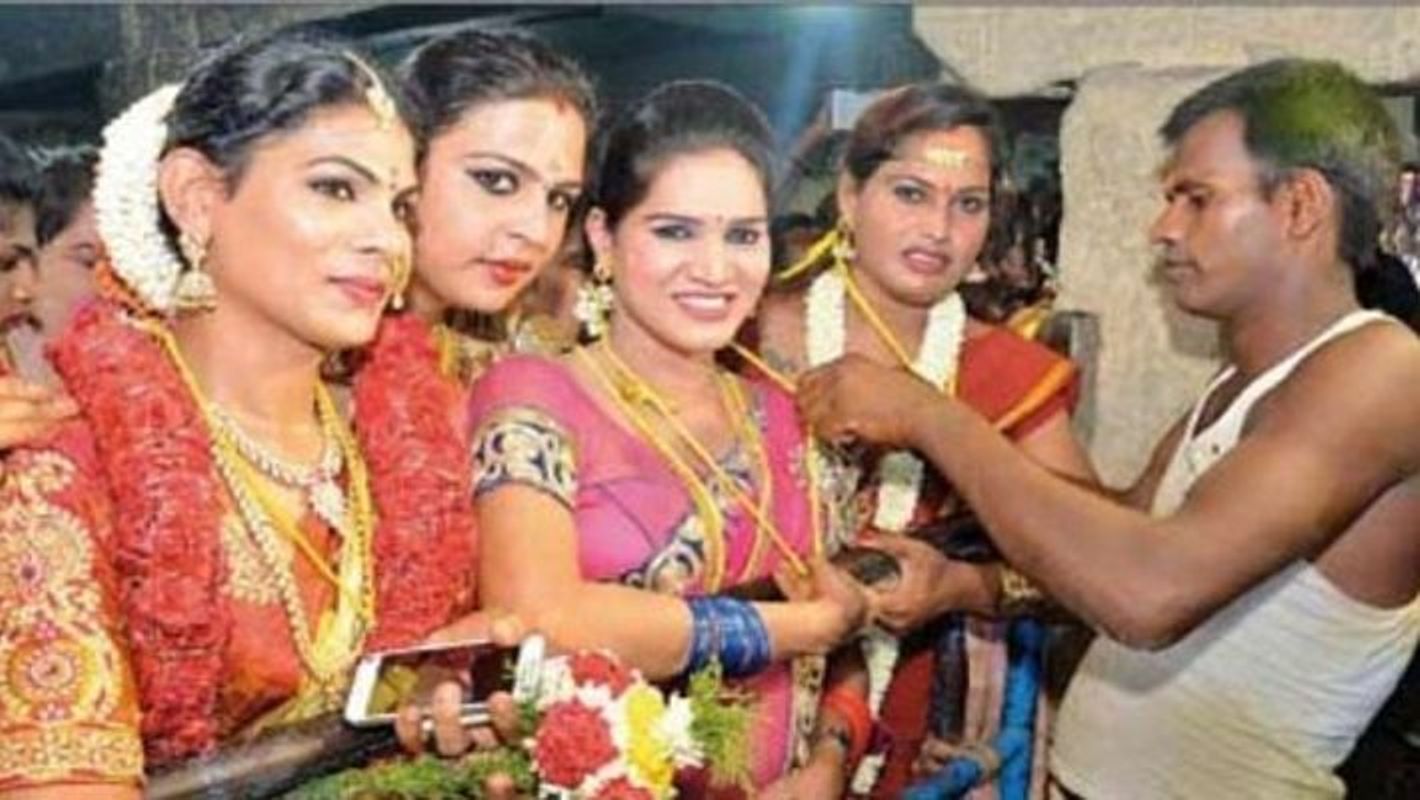
On the Tuesday, participants come to the temple in their finest clothes, garlanded, carrying offerings. Priests tie the thali, the sacred marriage thread, around thousands of necks through the night. Each one is married to Aravan. For that night, they are brides.
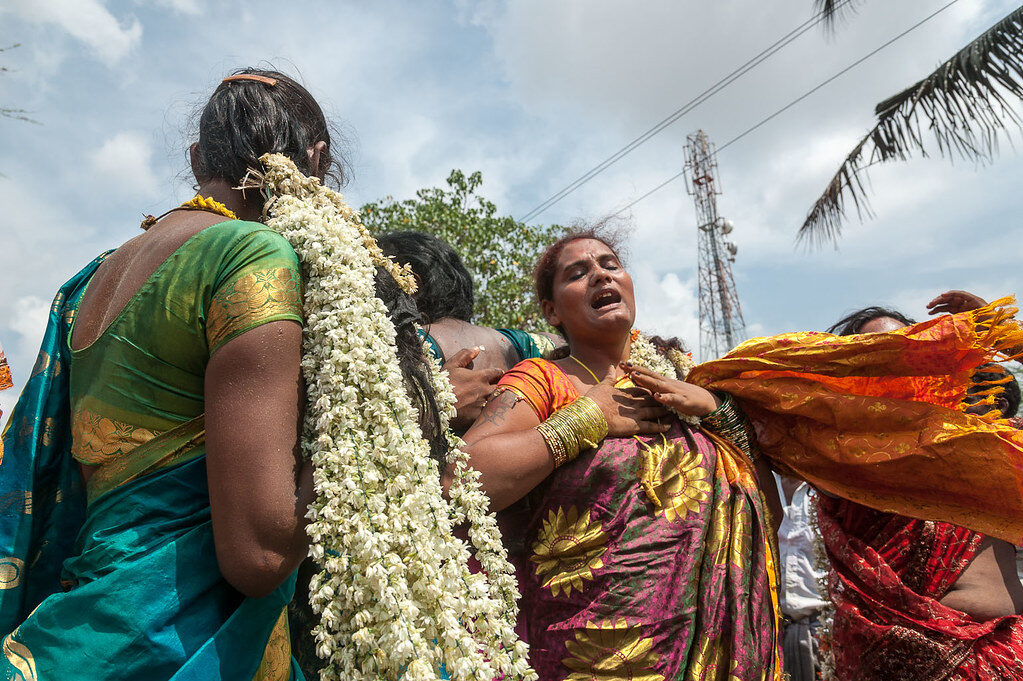
The next morning the temple chariot carries the deity out to enact his sacrifice, and the mood turns completely. The rites of widowhood are observed in the open, together:
- Bangles are broken, the traditional first act of grief.
- The thali is removed, the marriage ended as suddenly as it began.
- Kumkum is wiped from the forehead, and white replaces colour.
The marriage is symbolic. The grief is not. There is real weeping at Koovagam on that Wednesday morning, and anyone who has stood near it understands that something more than a re-enactment is taking place. A community that is often denied the ordinary rituals of love and loss claims them here, fully and publicly, once a year.
If you plan to attend, attend as a guest
Koovagam is open, and visitors are not unwelcome. But it is a religious gathering and a community’s own sanctuary, not an attraction laid on for outsiders. The difference between being present and being intrusive matters here more than at almost any festival we cover.
- Ask before you photograph, every time. Many participants live with real risk of exposure at home or at work. A camera pointed without consent can do lasting harm. If someone says no, that is the end of it.
- Use the right words. In Tamil the community’s own term is Thirunangai. Aravani, Kinnar and transgender women are all used more widely and are all fine. What is not fine is eunuch or transvestite, which you will still find in older travel writing and even on some official tourism pages. Both are inaccurate and the community rejects them. If you write or post about Koovagam, this is the easiest thing to get right.
- Dress modestly and behave as you would in any temple. This is an active place of worship throughout.
- Come to understand, not to collect. If your interest is in the story, the faith and the people, you will be received warmly. Koovagam has a long memory for those who turned up only to stare.
Where it happens, and how to reach it
The Koothandavar Temple stands in Koovagam, a village in Ulundurpettai taluk, in the Villupuram and Kallakurichi region of Tamil Nadu. It is a small place for most of the year and an extraordinary one for eighteen days.
- Nearest railway station: Villupuram Junction, roughly 30 to 35 kilometres away and well connected across Tamil Nadu.
- Nearest airports: Puducherry, around 80 kilometres, with Chennai the main long-haul gateway.
- By road: buses and share autos run to the temple from Ulundurpet and Villupuram, and services multiply during the festival.
- Where to stay: Villupuram is the practical base. Koovagam itself has very little accommodation, and what exists is taken by the community first, as it should be. Book early, because the festival fills the district.
April in inland Tamil Nadu is hot. Carry water, plan around the middle of the day, and remember that the most important hours here are at night and at first light.
Why we think Koovagam matters
Most of India’s famous festivals are about gods, harvests or victories. Koovagam is about belonging. It takes a community that much of the country still pushes to the margins and places it at the centre of a sacred story, as the bride of a god, with the whole village turned out to witness it.
Speak to participants and the ambitions you hear are entirely ordinary, which is precisely the point. To teach. To lead. To stand for election. To design, to paint, to be good at something and be known for it. Koovagam is where those hopes are spoken aloud among people who will not laugh at them. That is a rare thing anywhere in the world, and it happens every April in a village in Tamil Nadu.
Why plan Koovagam with Travebrate
Koovagam is not a festival you can turn up to on a guess. The date moves every year with the Chithirai full moon, the useful information is scattered and often wrong, and the three days each carry something completely different, so being there on the Wednesday instead of the Tuesday means seeing the mourning and missing the marriage entirely. Beds are scarce, Villupuram fills up, and knowing how to be present at a sacred community gathering without intruding is not something a booking site will ever tell you. This is exactly the work we do. We track India’s festival calendar ourselves, including the ones nobody else bothers to track, and we publish those dates free for anyone to use. When you plan with us, we take your travel dates, tell you which festivals you will actually cross paths with, and build the journey around the ones that matter to you, with the timings, the etiquette and the story behind each ritual so you understand what you are looking at. We do not book flights or hotels and we earn no commission from anyone, so nothing we suggest is shaped by what pays us. One personalised itinerary is a flat USD 100, and you book the trip your own way. Content creators, do reach out to us for special pricing.
Plan a journey around Koovagam
Tell us your travel dates and we will tell you which of India’s festivals you will cross paths with, and build your itinerary around the ones that move you. If Koovagam is one of them, we will help you attend it respectfully.
Plan my trip on WhatsAppPlan your India tripCustom India itineraries from USD 100 · We craft the experience; you book the trip your way.