

When Is Gotmar Festival? The Stone-Pelting Festival of Pandhurna Explained
Deep in the Chhindwara country of Madhya Pradesh, on the banks of a river called the Jam, two villages meet once a year for one of the most extraordinary and misunderstood festivals in India. It is called Gotmar, literally “stone-hitting,” and for a single day the river becomes the stage for a tradition several centuries old. It is fierce, it is ancient, and behind it lies a love story that the two villages have never forgotten.
When is Gotmar in 2026?
In 2026, Gotmar Mela falls on Saturday, 12 September, at Pandhurna, in the newly formed Pandhurna district of Madhya Pradesh. The fair is always held on the day after Bhadrapada Amavasya, the day that follows the Pola festival, so it lands in late August or September each year. Pola itself is a much loved cattle-thanksgiving festival of Maharashtra and the neighbouring districts, the day farmers oil their bullocks, paint and decorate them with colour, and lead them in procession through the village to honour the animals that work their fields. Gotmar follows the very next day.
What is the Gotmar festival?
Gotmar is a stone-pelting festival held between the people of two settlements that face each other across the Jam river, Pandhurna on one bank and Sawargaon on the other. For a single day, the two sides gather on their respective banks and hurl stones across the water in a ritual that the villages have kept alive for roughly three centuries, some say longer. It is tied to the worship of the local goddess Chandika Mata, and it draws thousands of onlookers every year.
We should be honest about what this is. Gotmar is not a gentle folk fair. It is intense, and every year many people are injured; over its long history there have been serious injuries and even deaths. In recent years the authorities deploy police, doctors and medical camps on the day, and the tradition remains a subject of real debate within India between those who see it as heritage and those who wish to see it made safe. We share it here as a remarkable cultural phenomenon to understand, not as something to take part in.
The love story behind Gotmar
Like the best of India’s festivals, Gotmar carries a legend at its heart, and it is a story of love across a divide. As the villages tell it, a young man from Pandhurna and a young woman from Sawargaon fell in love. The two settlements sat on opposite banks of the Jam, and the girl’s family would not agree to the match. Determined to be together, the couple tried to cross the river and elope.
As they crossed, the girl’s people saw them and, in fury, began to pelt the young man with stones. Hearing the commotion, the people of Pandhurna rushed to the far bank and threw stones back, trying to protect the couple and let them reach the other side. In the storm of stones that followed, over the water of the Jam, the two lovers are said to have died. Their bodies were carried from the river, worshipped at the Chandika temple, and given their last rites. Gotmar has been held ever since, in memory of that ill-fated love, an act of remembrance that the two villages re-enact rather than forget.
There is an older telling too, in which a ruler of Pandhurna carried away the beautiful daughter of the chief of Sawargaon, and the stone-throwing began as the two sides fought across the river. Whichever version you hear, the shape is the same: two banks, a forbidden union, and a river between them that the festival still commemorates.
What exactly happens on the day
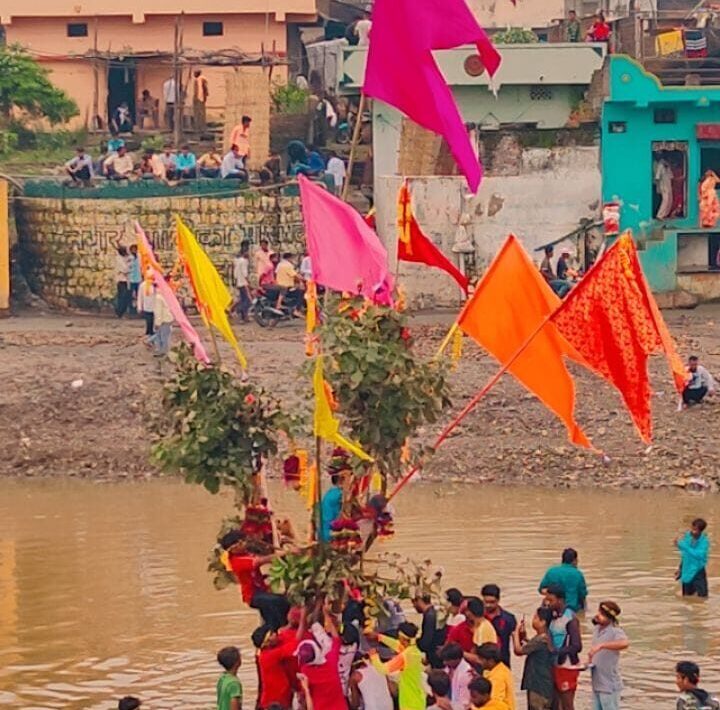
The day has a clear and dramatic shape. Early in the morning, a tall palash tree (the flame-of-the-forest) is cut and fixed upright in the middle of the Jam river bed, and a flag is raised at its top. The flag and its pole stand for the young woman of the legend. The goal echoes the story directly: in the tale, after the couple died the people of Pandhurna carried them to the Chandika Mata temple, which stands in Pandhurna, and so today the Pandhurna side must fight their way to the pole, seize the flag, the woman, and carry her to the Chandika temple before the day is out. The people of Sawargaon stand on the opposite bank with one duty, to stop them, defending the pole with a barrage of stones so that Pandhurna cannot reach the flag.
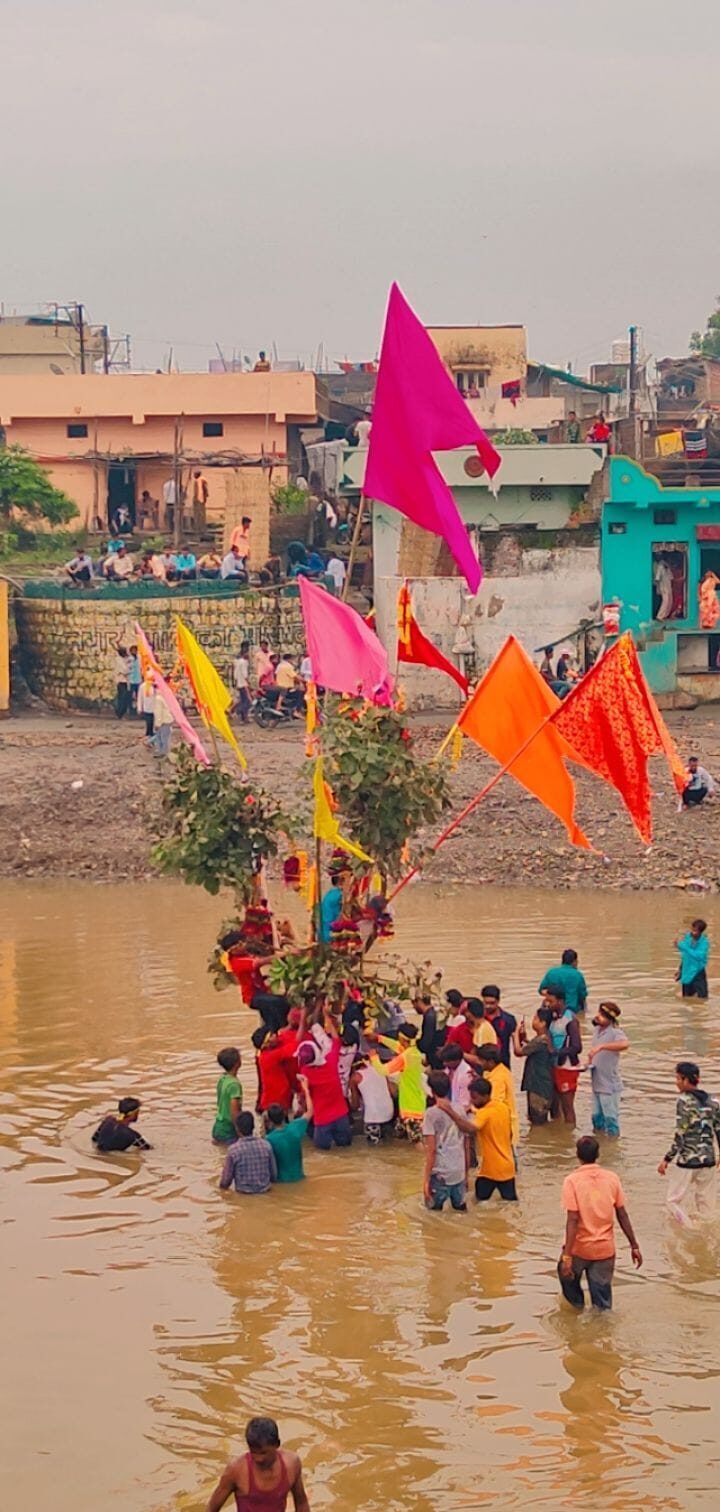
After the morning worship of Chandika Mata, at around 10 in the morning, the stone-throwing begins. From both banks, the two sides hurl river stones across the water. The bravest from Pandhurna wade into the river and rush the palash pole, trying to climb it and carry off the flag, the woman of the story, back toward the Chandika temple on their side, while the Sawargaon men rain stones down to stop them ever reaching it. It is loud, chaotic and charged with generations of rivalry and meaning.
The contest ends in one of two ways, and both are honoured. Either the Pandhurna side finally fights through, takes the flag and carries it to the Chandika temple, in which case they have won and the fair is over; or the sun sets before they manage it, in which case Sawargaon has held them off, and the fair ends there too. In the past a strong Sawargaon defence often ran the clock down to dusk, but these days, with spirited youth on both banks, either outcome is genuinely possible from year to year, and no one knows at 10 in the morning which way the day will go. At the finish, whichever side has prevailed, both villages come together to worship Chandika Mata, and the day closes in shared devotion. The scale is real: recent years have seen hundreds treated at the medical camps set up along the banks.
Where it happens, and how to witness it safely
Gotmar takes place at Pandhurna, on the Jam river, in Madhya Pradesh near the Maharashtra border, roughly a couple of hours from Nagpur, which is the most practical arrival city. It is very much a local, living tradition rather than a tourist spectacle, and that is exactly what makes witnessing it so extraordinary.
If you wish to see it, the only sensible way is from a safe distance, as an observer, never a participant. Stones travel far and fast, and the injured each year include bystanders. We would only ever plan this as a respectful, carefully positioned viewing, ideally with local guidance from people who know the ground, the timings and the safe vantage points. Understanding the story, the goddess, and the meaning behind the stones is what turns a startling sight into a profound one.
This is the kind of festival Travebrate exists for: little known outside its own region, impossible to understand without its story, and unforgettable when you do. If a journey through the heart of India around early September appeals to you, we can tell you whether your dates line up with Gotmar and how it might, carefully, be part of your trip.
Plan a trip around India’s living festivals
Tell us your travel dates and we will tell you which of India’s festivals, famous or almost unknown, you will be crossing paths with, and build your itinerary around the ones that move you.
Plan my trip on WhatsAppPlan your India tripCustom India itineraries from USD 100 · We craft the experience; you book the trip your way.